
Smarter Purchase Order Review with Agentic AI

Overview
The Cal Poly Digital Transformation Hub (DxHub), powered by Amazon Web Services (AWS), partnered with the University of California, San Diego (UC San Diego) Integrated Procure-to-Pay Solutions team to design and prototype a generative AI–driven workflow that modernizes how purchase orders (POs) are reviewed, vetted, and approved. UC San Diego was interested in a way to reduce the time and effort required for manual Purchase Order (PO) review without replacing human judgment. Working closely with procurement stakeholders, the DxHub team built an intelligent workflow using AWS generative AI capabilities to ingest PO documents, extract key details, and evaluate them against procurement rules and institutional policies. This engagement demonstrates how higher education institutions can responsibly adopt generative AI to streamline administrative operations while maintaining transparency, auditability, and governance.
Problem
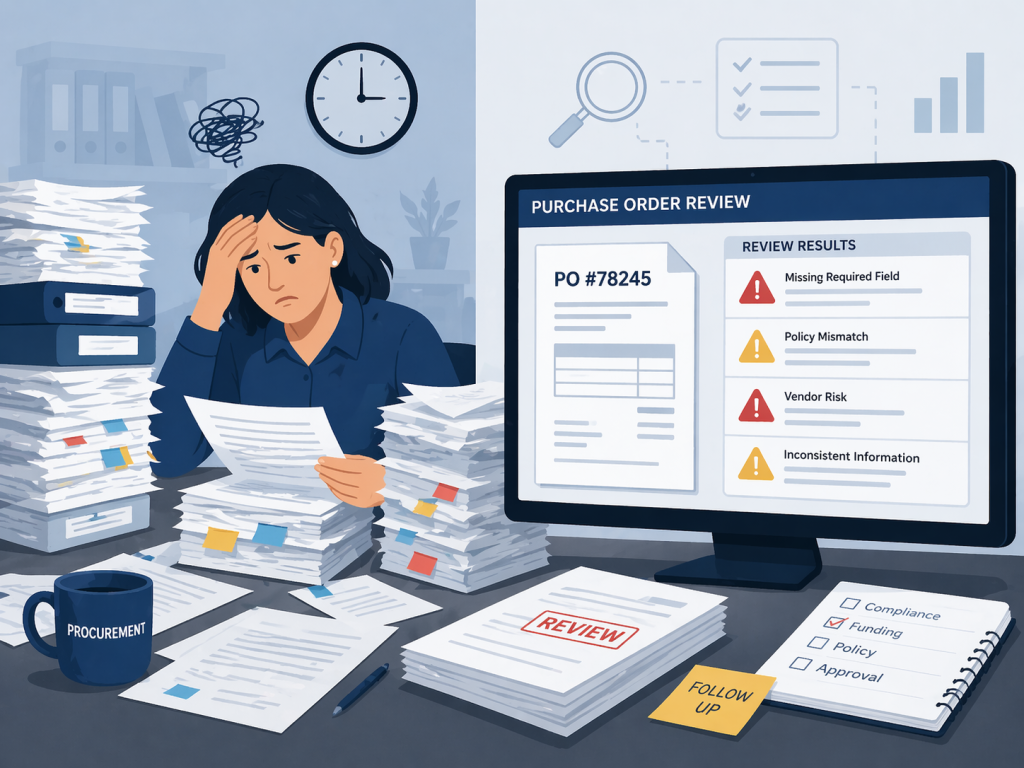
At UC San Diego, procurement buyers are responsible for carefully reviewing PO documents to ensure compliance with institutional policies, funding requirements, and purchasing guidelines. This review process is critical to maintaining fiscal responsibility, supporting sustainable and diverse suppliers, and protecting the university from financial and regulatory risk. Buyers have to spend time examining individual purchase orders to verify required fields, assess policy alignment, and identify potential issues or inconsistencies. Many of these checks are routine and redundant, yet they demand close attention to detail to avoid errors. As a result, procurement teams face slower turnaround times, higher cognitive load, and an increased risk of inaccuracies—particularly during peak purchasing periods. These delays can ripple across campus, slowing research, operations, and service delivery that depend on timely procurement. UC San Diego needed a solution that could accelerate the review process without sacrificing accuracy, oversight, or accountability. Specifically, the procurement team sought a way to reduce manual effort, surface potential issues earlier, and provide consistent, repeatable evaluations of purchase orders. The challenge was to enhance speed and precision while preserving human judgment and aligning with UC San Diego’s broader goals of efficiency, compliance, and responsible purchasing.
Innovation In Action
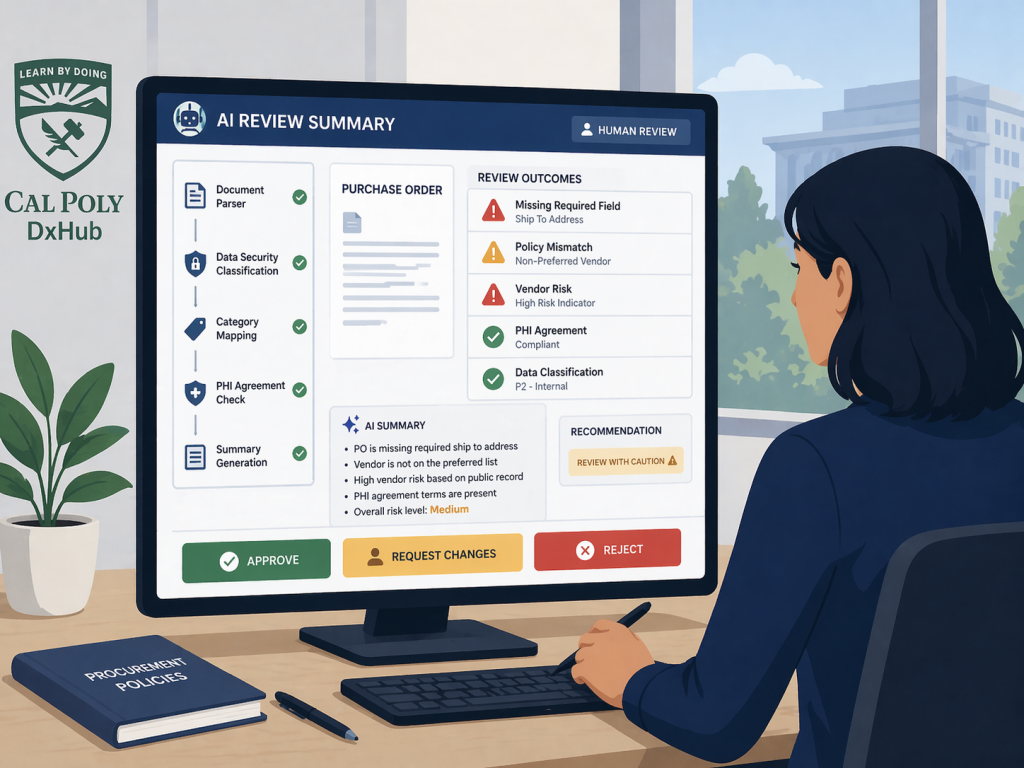
To modernize and scale purchase order review, the DxHub team designed and implemented an agentic, generative AI–driven workflow that ingests procurement documents and references a structured set of compliance and risk checks to support buyer decision-making. Rather than relying on a single model pass, the solution orchestrates multiple specialized AI agents, each responsible for a distinct aspect of the review process, enabling greater accuracy, transparency, and extensibility. At the front of the workflow, a Document Parser Agent classifies incoming files by document type and dynamically selects the appropriate parsing strategy and prompt. Parsed outputs are written to a shared state that downstream agents can reliably consume. A Data Security Classification Agent then evaluates service and vendor information to determine data sensitivity levels (P1–P4), using LLM reasoning to detect indicators of sensitive or regulated data and returning structured JSON with both classification and justification. In parallel, a Purchasing Categories Mapping Agent applies contextual reasoning to map each purchase order to the appropriate procurement category, supporting downstream policy evaluation and reporting. Additional agents perform targeted compliance checks, including a PHI Agreement Check Agent that scans documents for Protected Health Information (PHI), HIPAA-related clauses, and required agreement language. Once all checks are complete, a summarization agent consolidates outputs from each agent into a single, human-readable summary that clearly surfaces risks, missing information, and review signals for procurement professionals. The solution ensures scalability, security, and auditability while allowing UC San Diego to evolve rules, agents, and checks over time—demonstrating how agentic AI can augment complex administrative workflows without replacing human oversight.
Technical Solution
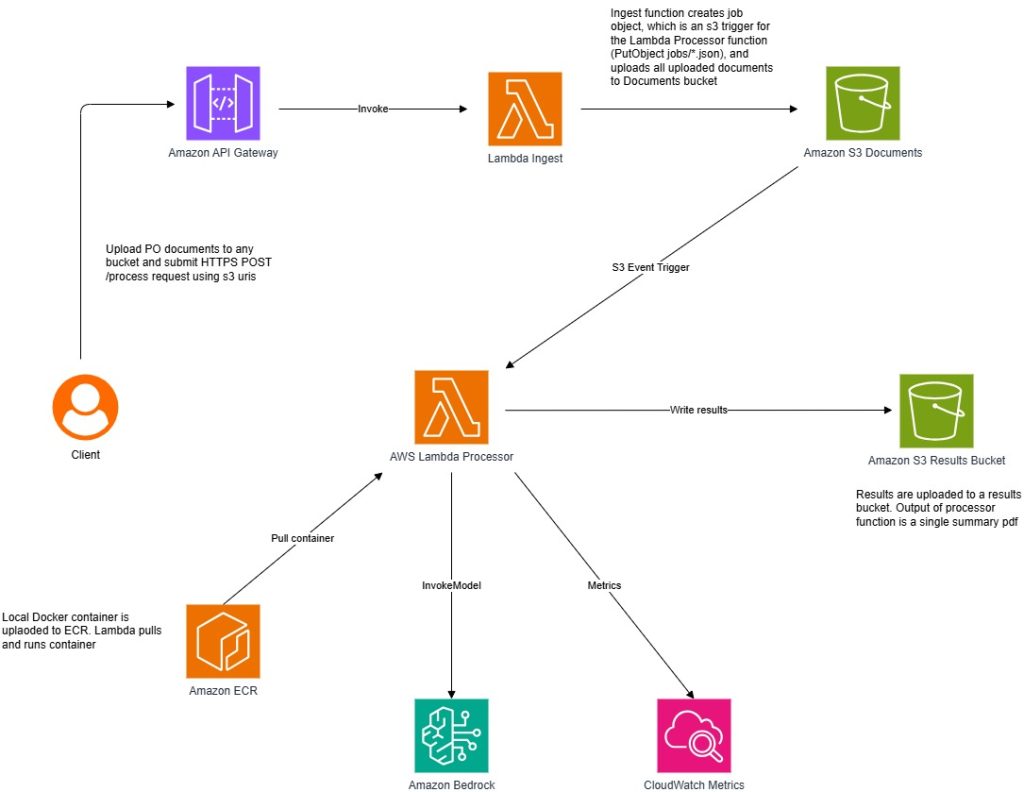
The solution is built on a serverless, cloud-native architecture using managed AWS services to ensure scalability, security, and ease of integration. A RESTful interface exposed through AWS API Gateway allows external systems to easily invoke the workflow, while core application logic and agent orchestration are executed within AWS Lambda. This design enables the agentic workflow to scale automatically with procurement volume and evolve without infrastructure management overhead. During document processing, purchase order files are securely stored in Amazon S3, where they are retrieved by Lambda functions for parsing and analysis. As documents move through the workflow, multiple specialized agents are invoked to perform classification, compliance checks, and reasoning tasks. Each agent produces both concrete decisions and concise, human-readable explanations, supporting transparency and auditability throughout the review process. Generative AI reasoning is powered by Anthropic Claude Sonnet accessed through Amazon Bedrock. This enables the system to perform nuanced document interpretation, data sensitivity classification, and policy-aware analysis while returning structured outputs suitable for downstream systems. Together, these services form a flexible and extensible foundation for modernizing procurement workflows with responsible, explainable generative AI.



Supporting Documents
| Source Code | All of the code and assets developed during the course of creating the prototype. |
About the DxHub
The Cal Poly Digital Transformation Hub (DxHub) is a strategic relationship with Amazon Web Services (AWS) and is the world’s first cloud innovation center supported by AWS on a University campus. The primary goal of the DxHub is to provide students with real-world problem-solving experiences by immersing them in the application of proven innovation methods in combination with the latest technologies to solve important challenges in the public sector. The challenges being addressed cover a wide variety of topics including homelessness, evidence-based policing, digital literacy, virtual cybersecurity laboratories and many others. The DxHub leverages the deep subject matter expertise of government, education, and non-profit organizations to clearly understand the customers affected by public sector challenges and develop solutions that meet the customer needs.