
Empowering Teachers to Serve Diverse Learners with AI: K-12 Co-Teacher
Overview
The Cal Poly Digital Transformation Hub (DxHub), powered by Amazon Web Services (AWS), partnered with educators to tackle the growing challenge of serving diverse learners in K-12 classrooms. Teachers are responsible for meeting the needs of students receiving special education services, those with 504 accommodations, English language learners, and gifted students requiring enrichment. Each group comes with unique supports and instructional requirements, which must be consistently applied to ensure success.
To address this, the DxHub developed K-12 Co-Teacher, an AI-powered classroom assistant that surfaces required accommodations and provides tailored guidance to help teachers deliver inclusive instruction more
Problem
While critical support for students is outlined in Individualized Education
Plans (IEPs), 504 plans, and psychological reports, these documents often stretch across dozens of pages and are written in technical language. Teachers must sift through this information, translate it into actionable lesson plans, and manage classrooms of 30–40 students across multiple sections.
This creates three core challenges:
- Time Burden: Teachers spend an additional 2-3 hours per week per class section cross-referencing documents with lesson plans.
- Consistency of Supports: When accommodations are overlooked or applied inconsistently, students risk missing critical opportunities for academic and behavioral growth.
- Teacher Burnout: The growing administrative workload contributes to stress and fatigue, reducing time available for direct engagement with students. These challenges underscored the need for an intelligent system to help educators efficiently apply supports while maintaining equity in the classroom.
Innovation In Action
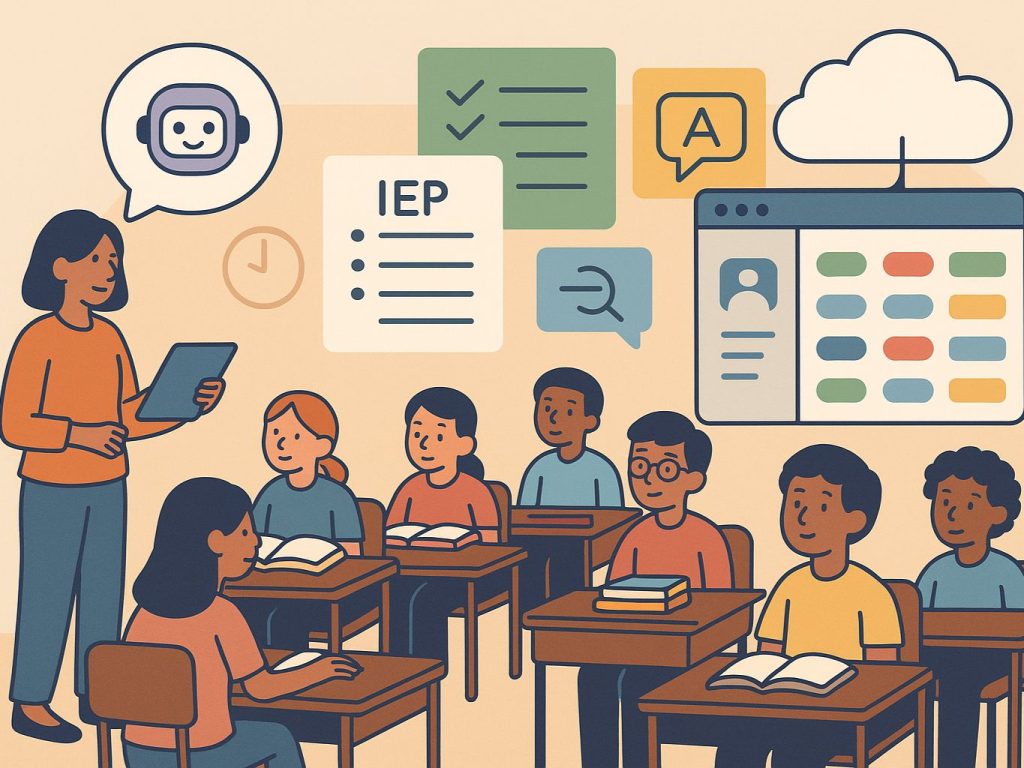
To reduce this burden, the DxHub collaborated with educators to design K-12 Co-Teacher, an AI-powered assistant that integrates student documentation with daily instruction.
Key innovations include:
- Accommodation Surfacing: Required support from IEPs, 504 plans, and evaluation reports are highlighted first, giving teachers a reliable foundation rooted in official student profiles.
- Class & Individual Views: Teachers can access class-level summaries or drill down into individual student profiles to receive targeted guidance.
- Living Records: Teachers can record notes over time, building a continuously updated view of student progress.
- Inclusive Strategies: The assistant flags potential challenges in lesson content and recommends strategies aligned with documented supports.
This integration streamlines lesson planning and ensures students consistently receive the support they are entitled to, making differentiated instruction more reliable and sustainable.
Technical Solution
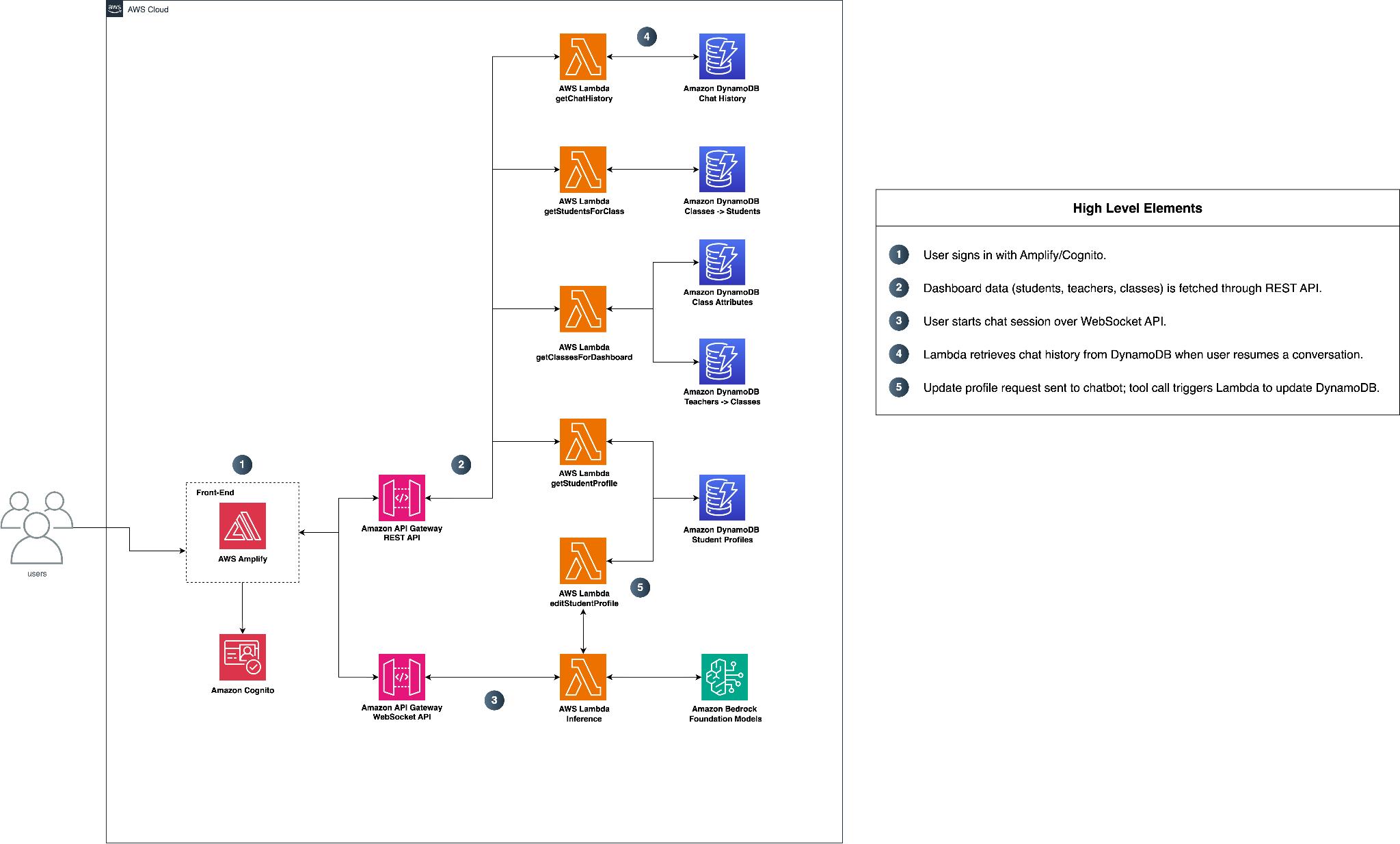
The K-12 Co-Teacher solution leverages a fully serverless, API-driven architecture built on AWS to ensure scalability, reliability, and security in a classroom setting. The system is designed to integrate lesson content with student profiles, surfacing required accommodations directly alongside instruction.
At the front end, the application is hosted on AWS Amplify, with authentication and secure sign-in managed by Amazon Cognito. Once authenticated, educators access dashboard data, including students, teachers, and class rosters, through a REST API exposed by Amazon API Gateway.
Core application logic runs on AWS Lambda, with individual functions responsible for retrieving class rosters, student profiles, and chat history from Amazon DynamoDB. A separate inference Lambda function connects to Amazon Bedrock, powered by the Anthropic Claude Sonnet 3.7 foundation model, to analyze lesson content and surface IEP accommodations and inclusive strategies.
For real-time interaction, the system uses Amazon API Gateway WebSocket APIs, allowing teachers to initiate chat sessions and receive contextual guidance during lesson planning. Updates made in the chat, such as adding notes or adjusting a student profile, trigger Lambda functions that securely write back to DynamoDB. This creates a living record that evolves with classroom needs.
This architecture not only ensures low-latency access to critical classroom data but also minimizes operational overhead through fully managed AWS services. The result is a secure, scalable, and responsive platform that gives educators actionable insights while safeguarding sensitive student information.

Next Steps
Early results show that Co-Teacher can significantly reduce the time teachers spend on lesson planning by surfacing required accommodations, improving consistency across classrooms, and providing actionable insights that help educators tailor instruction to individual student needs.
Looking ahead, the same approach can be extended beyond lesson planning to support progress monitoring, behavioral interventions, and family-facing summaries, building toward a more unified and accessible system of student support. As classrooms grow more diverse and personalized learning becomes the norm, tools like Co-Teacher demonstrate how generative AI can help schools apply student supports more efficiently while upholding the high standards required for equitable instruction.
Supporting Documents
| Source Code | All of the code and assets developed during the course of creating the prototype. |
About the DxHub
The Cal Poly Digital Transformation Hub (DxHub) is a strategic relationship with Amazon Web Services (AWS) and is the world’s first cloud innovation center supported by AWS on a University campus. The primary goal of the DxHub is to provide students with real-world problem-solving experiences by immersing them in the application of proven innovation methods in combination with the latest technologies to solve important challenges in the public sector. The challenges being addressed cover a wide variety of topics including homelessness, evidence-based policing, digital literacy, virtual cybersecurity laboratories and many others. The DxHub leverages the deep subject matter expertise of government, education, and non-profit organizations to clearly understand the customers affected by public sector challenges and develop solutions that meet the customer needs.