
Promoting Supplier Diversity with Agentic AI Procurement Tooling

Overview

 The California Polytechnic State University, San Luis Obispo (Cal Poly) Digital Transformation Hub (DxHub), powered by Amazon Web Services (AWS), developed Enterprise Locator for Veteran and Independent Suppliers (E.L.V.I.S.), an intelligent research tool that helps procurement professionals identify and evaluate certified small businesses—including veteran-owned and other diverse suppliers—while maintaining fiscal responsibility and quality standards.

As part of the California State University (CSU) system, Cal Poly maintains goals of 25% small business utilization and 3% disabled/veteran business enterprise participation as part of its commitment to supplier diversity. With over $300 million in purchase volume annually, there is significant opportunity to support diverse suppliers while ensuring competitive pricing and quality goods and services for the university.

E.L.V.I.S. streamlines the research process for procurement professionals by automating time-intensive tasks such as searching certification databases and compiling supplier information.

The system analyzes procurement data, verifies supplier certifications through official databases, and prepares research materials for review—enabling procurement staff to make more informed decisions about supplier diversification. Human oversight remains central: procurement professionals review all findings, make final supplier selections, and manage all supplier relationships.

Problem

Cal Poly’s procurement department works diligently to advance supplier diversity goals while balancing multiple priorities: fiscal responsibility, competitive pricing, quality assurance, and operational efficiency. Progress toward diversity targets requires significant research to identify qualified, certified small businesses that can provide the necessary goods and services at competitive prices. 

The research process for identifying and vetting potential diverse suppliers is time-intensive. Procurement professionals search for certified suppliers, verify credentials through multiple databases, assess capabilities, and evaluate whether they can meet the university’s quality and budgetary requirements. With hundreds of suppliers and thousands of transactions, thorough research for supplier diversification opportunities can be challenging to conduct systematically alongside other procurement responsibilities.

Finding certified diverse businesses requires navigating multiple databases, including CaleProcure (California’s official small business certification registry), as well as researching supplier capabilities, contact information, and service areas. This investigative work requires expertise and time that procurement professionals must balance against their other operational demands.

The department seeks an intelligent research tool that can help procurement professionals more efficiently identify certified diverse suppliers, verify their credentials, and compile relevant information—enabling staff to make well-informed decisions about supplier diversification while maintaining the university’s standards for quality, value, and compliance.

Innovation In Action

E.L.V.I.S. is an AI-powered research assistant that helps procurement professionals identify and evaluate certified diverse suppliers more efficiently. The tool streamlines research tasks while keeping human expertise and judgment at the center of all procurement decisions.

E.L.V.I.S. begins by analyzing procurement data from Excel spreadsheets containing transaction history. The system calculates current diversity metrics and identifies suppliers where exploring diverse alternatives might be beneficial. Procurement professionals review these insights and select which suppliers they want to research, maintaining full control over the research direction.
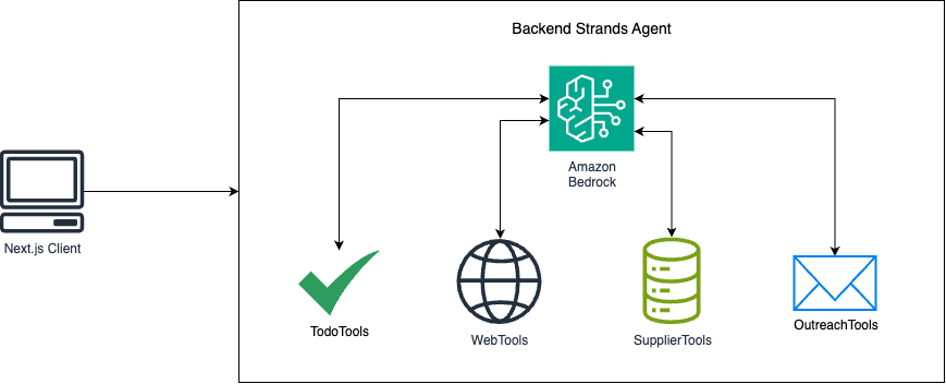
When a procurement professional initiates research on a supplier, E.L.V.I.S.’s AI agent creates a structured research plan, typically targeting three certified diverse business alternatives. The system conducts web searches to identify businesses offering similar products or services, then automatically queries the CaleProcure database to verify that each potential supplier holds valid certifications (such as small business, veteran-owned, etc). This verification ensures that all recommendations meet official certification standards.

After verifying certification, E.L.V.I.S. compiles detailed information about each supplier: contact details, specific certification types, service areas, and business capabilities. The system then prepares draft outreach materials and call preparation notes that procurement professionals can review, customize, and use as appropriate.

Throughout the process, E.L.V.I.S. maintains detailed documentation and logs all findings for audit trails. Procurement professionals monitor the agent’s progress in real-time through a web interface and review all compiled research. The procurement professional will make all final decisions about which suppliers to contact, evaluate, and potentially engage—applying their expertise in quality assessment, pricing negotiation, and vendor relationship management.

E.L.V.I.S. enhances procurement professionals’ capacity by handling time-intensive research tasks, enabling staff to focus more time on strategic evaluation, relationship building, and decision-making. The tool helps staff make more informed progress toward diversity goals while maintaining the university’s commitment to fiscal responsibility and quality standards.

Technical Solution

E.L.V.I.S. leverages a sophisticated AI agent architecture built on AWS services, combining advanced language models with intelligent automation tools to create a seamless research and verification workflow.

The system’s frontend uses Next.js, a modern React-based framework that provides a responsive, intuitive interface for procurement professionals. This interface allows users to upload procurement data, monitor AI agent progress in real-time, and review research results—all through a clean, web-based dashboard. The frontend communicates with the backend through a FastAPI application, a high-performance Python framework chosen for its excellent support of asynchronous operations and real-time data streaming.

At the core of E.L.V.I.S. is an intelligent AI agent powered by Amazon Bedrock, specifically utilizing the Claude 4.5 Sonnet model from Amazon. This advanced large language model provides the reasoning capabilities that allow E.L.V.I.S. to plan research strategies, interpret search results, extract relevant information from web pages, and generate personalized outreach communications. The system also leverages Nova Pro and Nova Lite models for specific tasks, optimizing performance and cost across different types of AI operations.

The agent framework builds on Strands, AWS’s agent orchestration system, which enables complex multi-step workflows where the AI agent can use various tools sequentially to accomplish research objectives. E.L.V.I.S. implements four specialized tool categories:

  1. TodoTools manage the agent’s task list, allowing it to create research objectives, track progress, and verify completion using AI-based quality checks. This ensures that each research cycle follows a structured methodology and that no steps are inadvertently skipped.
  2. WebTools provide browser automation capabilities through Playwright, an async-compatible framework that allows the AI agent to navigate websites, search databases, and extract information as a human researcher would. These tools integrate directly with Bedrock, allowing the AI to interpret page content and make intelligent decisions about what information to extract.
  3. SupplierTools interface specifically with the CaleProcure database—California’s official small business certification registry. These tools enable automated searches for supplier certifications and extraction of verified credential data, ensuring that all recommendations meet official certification standards.
  4. OutreachTools generate personalized communication materials, including email drafts and phone call preparation scripts, tailored to each verified supplier based on their specific certifications, capabilities, and the procurement context.

Real-time monitoring happens through Server-Sent Events (SSE), which stream log data from the backend to the frontend as the agent works. This provides procurement specialists with transparency into the research process and confidence that the system is functioning correctly.

The system incorporates comprehensive token tracking, monitoring AI model usage across both agent reasoning and tool execution. This cost transparency allows administrators to understand the economics of automated research and optimize system configuration for efficiency.

Data processing utilizes Pandas, Python’s powerful data analysis library, to ingest procurement spreadsheets, calculate diversity metrics, and identify high-priority supplier substitution opportunities. All research results, logs, and outreach materials are organized into timestamped execution directories, creating a complete audit trail for each research run.

Authentication and session management use token-based sessions with secure persistence, ensuring that procurement specialists can access their research history across multiple sessions while maintaining appropriate security controls.

The entire architecture is designed to be both powerful and maintainable, leveraging AWS’s managed services to minimize operational overhead while providing the sophisticated AI capabilities needed to automate complex research workflows. The result is a system that can scale to handle Cal Poly’s entire supplier portfolio while maintaining the verification rigor and compliance documentation required for public sector procurement.

Student Spotlight

Gus Flusser

Software Developer

About the DxHub

The Cal Poly Digital Transformation Hub (DxHub) is a strategic relationship with Amazon Web Services (AWS) and is the world’s first cloud innovation center supported by AWS on a University campus. The primary goal of the DxHub is to provide students with real-world problem-solving experiences by immersing them in the application of proven innovation methods in combination with the latest technologies to solve important challenges in the public sector. The challenges being addressed cover a wide variety of topics including homelessness, evidence-based policing, digital literacy, virtual cybersecurity laboratories and many others. The DxHub leverages the deep subject matter expertise of government, education, and non-profit organizations to clearly understand the customers affected by public sector challenges and develop solutions that meet the customer needs.