
Team: Student-Centered Scheduler
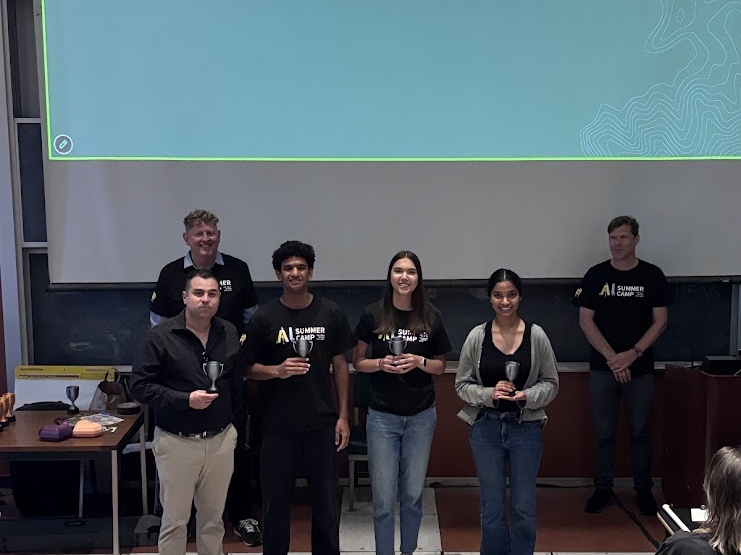
- Ashmeet Kaur
- John Khazraee
- Kseniia Oblasova
- Rohan Gopalan
“You’re about to click the register button for a class and then that red pop-up with the conflict time shows up.”
Problem
De Anza College departments build course schedules independently—each chair works from their own spreadsheets, emails, and Word documents without cross-department coordination. As a result, courses required in the same quarter by the same program map can end up scheduled at overlapping times, limiting students’ ability to carry a full course load. With ~80 program maps published as static PDFs and no programmatic way to verify whether the published schedule supports completing any given map on time, potential conflicts are difficult to surface before registration. This manual process—spanning per-department spreadsheets, divisional roll-ups, and final data entry by the Office of Instruction—contributes to longer time-to-degree and under-enrolled course sections, with limited tooling to scale coordination across the college.
Technical Solution
The Student-Centered Scheduler team developed a scheduling platform that ingests the college’s published schedule, program pathway maps, and de-identified enrollment history into a structured data layer built on AWS DynamoDB, with Amazon S3 staging the raw source files. Python ingestion scripts parse the Excel/CSV class schedule (via openpyxl) and verbose pathway course text into normalized, canonical course records in Amazon DynamoDB. AWS Lambda functions then run cross-department conflict detection, flagging time and section overlaps that prevent students from following their program maps. An AI-powered assistant built on Amazon Bedrock AgentCore (using the Strands Agents framework) lets schedulers and students ask natural-language questions about pathway requirements, section conflicts, class times and rooms, and modality; the assistant answers by calling DynamoDB read tools rather than guessing. A React-based frontend provides interactive filtering across departments and programs, a hierarchical analysis dashboard visualizing all pathway conflicts, and a chat interface to the AI assistant. The system replaces the disconnected spreadsheet-and-email workflow with a single coordinated view—enabling cross-department schedule alignment, surfacing conflicts before publication.
Showcase
| Presentation Recording | A recording of AI Summer Camp students presenting their project. |
| Slideshow | The accompanying slides shown in the video. |
| Source Code | All of the code and assets developed during the course of the AI Summer Camp. |
About the DxHub
The Cal Poly Digital Transformation Hub (DxHub) is a strategic relationship with Amazon Web Services (AWS) and is the world’s first cloud innovation center supported by AWS on a University campus. The primary goal of the DxHub is to provide students with real-world problem-solving experiences by immersing them in the application of proven innovation methods in combination with the latest technologies to solve important challenges in the public sector. The challenges being addressed cover a wide variety of topics including homelessness, evidence-based policing, digital literacy, virtual cybersecurity laboratories and many others. The DxHub leverages the deep subject matter expertise of government, education, and non-profit organizations to clearly understand the customers affected by public sector challenges and develop solutions that meet the customer needs.