
Team: CoReview AI
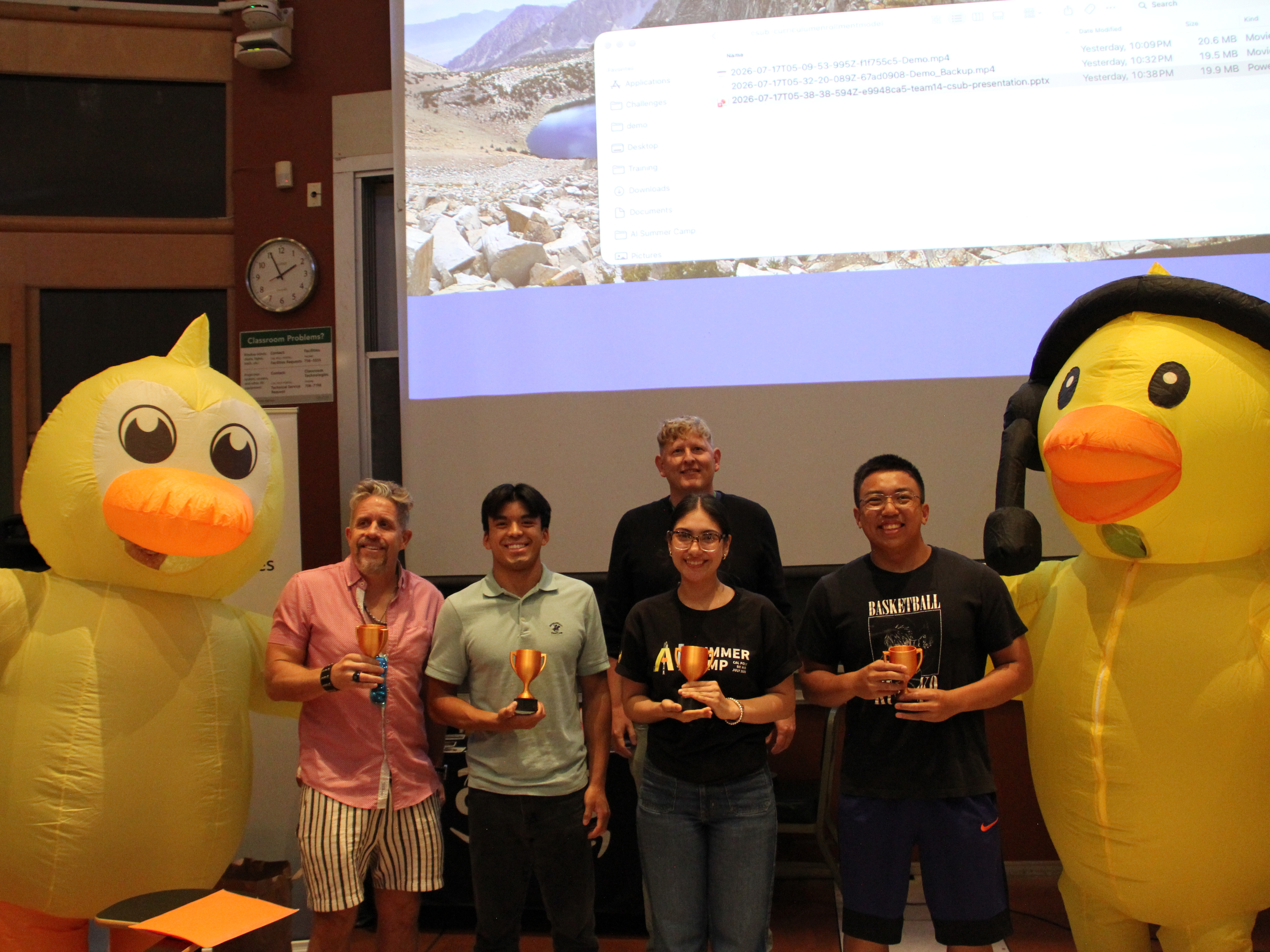
Team Participants:
Jasmine Davila
Ethen Le
Samson Chang
Joshua Tenney
William Delgado
“They require 3 human reviews by policy, which means at 8000 applications, we’re talking about 24,000 reviews a year.”
Problem
The SJSU Scholarship Office faces significant capacity challenges in processing over 8,000 scholarship applications annually, with each application requiring at least two manual rubric-based reviews by volunteer readers from across campus. The existing paper-based workflow creates severe reviewer fatigue during the compressed award window, as readers manually score multiple criteria and extract supporting evidence from each application. This labor-intensive process leads to predictable variation between reviewers, extended processing timelines that delay awards to students, and workload challenges that strain both Scholarship Office staff and volunteer readers who struggle to maintain consistency across thousands of evaluations.
Technical Solution
The CoReview AI team developed an evidence-based scholarship evaluation system for San Jose State that transforms how faculty review thousands of applications by converting subjective rubric language into structured questionnaires, generating AI-powered first-pass scores with cited evidence, and running in shadow mode alongside human reviewers to measure agreement across 8,000+ annual applications. The solution is built using a React dashboard hosted on AWS Amplify (full-stack hosting), with a FastAPI backend running as AWS Lambda (serverless compute) functions behind Amazon API Gateway, and all rubrics, applications, and scores stored in Amazon DynamoDB (NoSQL database). When faculty upload a rubric PDF, Amazon Bedrock (managed generative AI) using Claude Opus models transforms it into a structured questionnaire where each rubric criterion becomes true/false questions with verbatim option labels lifted from the original document, ensuring the AI never invents scoring language, and faculty review and lock the questionnaire before any grading occurs. Faculty upload application files as Excel spreadsheets with varying column structures per scholarship and year, which the system normalizes into clean application records stored in DynamoDB. For each application, Amazon Bedrock evaluates every question by first extracting verbatim evidence sentences from the essay, then producing reasoning about why those sentences satisfy or fail the question, and finally deciding a verdict of true, false, or cannot-tell, with this deliberate evidence-first ordering preventing rationalization. Scoring math converts the verdicts into the rubric’s actual numeric scale using per-rubric weights and ranges, producing per-criterion scores, a composite score, and a confidence flag, with all evidence quotes and reasoning preserved. The system runs in shadow mode where AI scores and human reviewer scores are compared through variance analysis that surfaces disagreements for calibration, with human reviewers using the dashboard to view AI recommendations with supporting evidence and make the final approval decision on each application, giving San Jose State a measured path to human-AI collaboration where benchmark data proves reliability before AI recommendations influence award decisions.
Showcase
| Presentation Recording | A recording of AI Summer Camp students presenting their project. |
| Slideshow | The accompanying slides shown in the video. |
| Source Code | All of the code and assets developed during the course of the AI Summer Camp. |
About the DxHub
The Cal Poly Digital Transformation Hub (DxHub) is a strategic relationship with Amazon Web Services (AWS) and is the world’s first cloud innovation center supported by AWS on a University campus. The primary goal of the DxHub is to provide students with real-world problem-solving experiences by immersing them in the application of proven innovation methods in combination with the latest technologies to solve important challenges in the public sector. The challenges being addressed cover a wide variety of topics including homelessness, evidence-based policing, digital literacy, virtual cybersecurity laboratories and many others. The DxHub leverages the deep subject matter expertise of government, education, and non-profit organizations to clearly understand the customers affected by public sector challenges and develop solutions that meet the customer needs.