
Team: Student Success Navigator
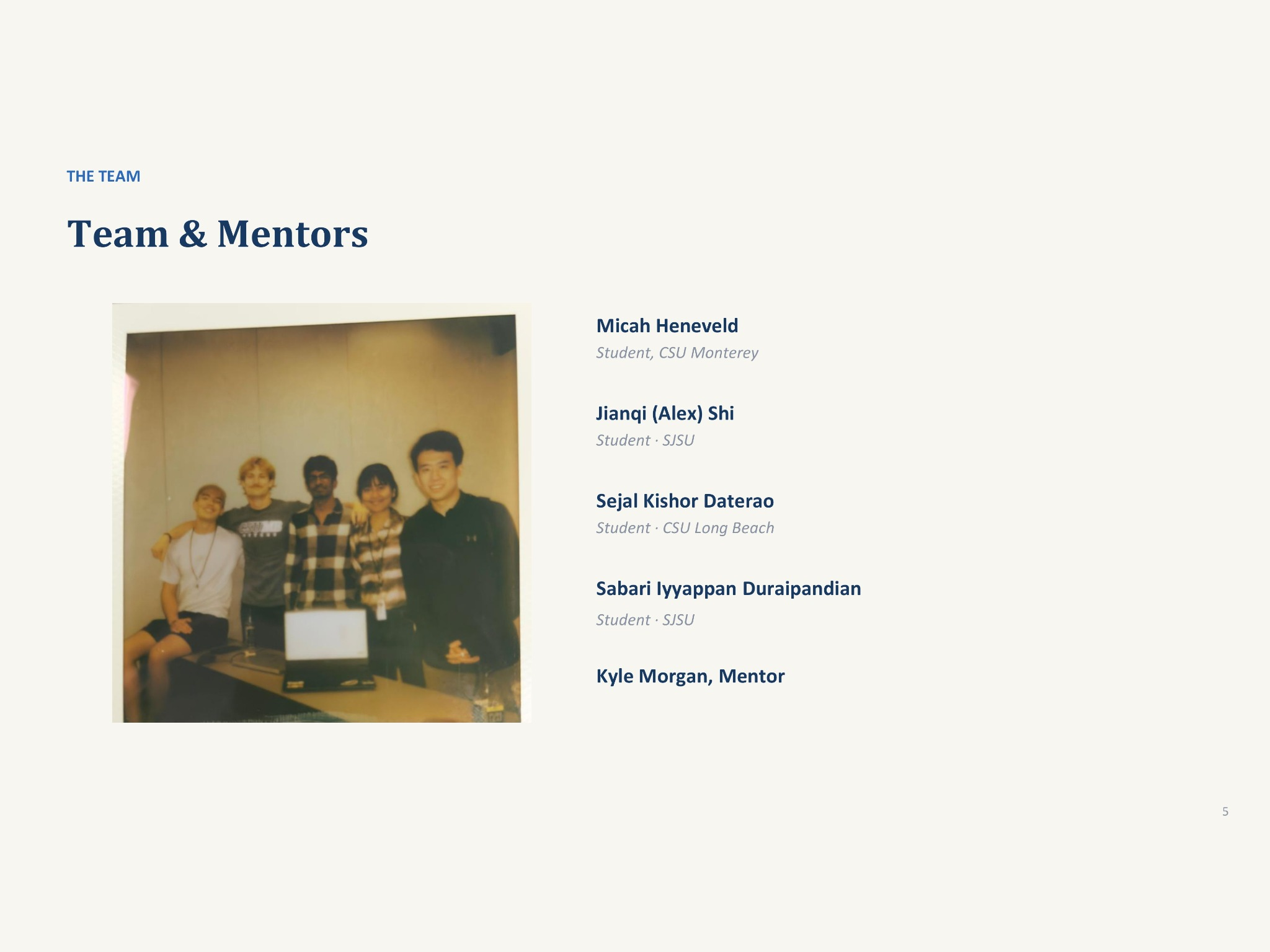
Team Participants:
Micah Heneveld (California State University, Monterey Bay)
Sabari Iyyappan Duraipandian (San Jose State University)
Jianqi (Alex) Shi (San Jose State University)
Sejal Kishor Daterao (California State University, Long Beach)
“SJSU recognized that students are not getting to use the resources effectively and efficiently, so the president required a system that brings students closer with resources.”
Problem
At San Jose State University, students seeking help with tutoring, financial aid, career services, EOP, or accessibility support face an ‘opportunity-rich but navigation-poor’ environment where resource information is scattered across multiple departmental websites with no unified entry point. Students must rely on tribal knowledge to navigate office-to-office referral chains, and many who are hesitant to ask staff for help in person give up before connecting with the services they need. This fragmentation pulls staff away from direct service delivery to handle high volumes of routing questions that could be self-served, while students waste significant time searching disconnected websites before finding the right resource for their situation.
Technical Solution
The Student Success Navigator team developed a conversational AI triage assistant called Sammy for San Jose State that routes students to campus resources by interpreting natural-language questions and connecting them to tutoring, financial aid, career services, EOP, and accessibility support offices with grounded guidance and citation cards linked to official SJSU pages. The solution is built using an Astro and React frontend with a FastAPI backend that implements a safety-first architecture where crisis keywords like suicide, self-harm, or assault are matched deterministically before any AI processing, triggering an immediate handoff with 988 Lifeline, CAPS, and emergency contacts without model improvisation. Campus resource information is stored as Markdown documents with metadata sidecars in Amazon S3 (cloud storage), which feeds into Amazon Bedrock Knowledge Bases (managed RAG) that uses Amazon Titan Text Embeddings to create vector representations stored in Amazon OpenSearch Serverless (search and vector index), enabling semantic search across 800+ official SJSU pages. When a student asks a question that passes the safety gate, the backend calls the Amazon Bedrock (managed generative AI) Converse API with Claude Sonnet 4.6 models in an agent loop where the model decides whether to retrieve campus resources by calling a retrieve tool that queries the Knowledge Base or to respond conversationally without retrieval, and when retrieval occurs, the system shapes the returned chunks into deduplicated citation cards showing the source URL, page title, and relevant excerpts. The agent submits its final answer through a structured tool call that bundles conversational text with statement batches and resource cards, ensuring responses are grounded in exact text from official pages with citations, and the system includes Amazon Cognito (authentication) infrastructure for Google OAuth with @sjsu.edu pre-sign-up validation, though authentication is not yet connected to the chat interface. This architecture provides students a low-barrier self-service channel that offloads routine navigation questions from staff, reduces office-to-office referral chains by routing directly to the correct service, and improves resource discoverability for students hesitant to ask for help in person, with the deterministic safety gate ensuring crisis situations bypass AI entirely for immediate human support.
Showcase
| Presentation Recording | A recording of AI Summer Camp students presenting their project. |
| Slideshow | The accompanying slides shown in the video. |
| Source Code | All of the code and assets developed during the course of the AI Summer Camp. |
About the DxHub
The Cal Poly Digital Transformation Hub (DxHub) is a strategic relationship with Amazon Web Services (AWS) and is the world’s first cloud innovation center supported by AWS on a University campus. The primary goal of the DxHub is to provide students with real-world problem-solving experiences by immersing them in the application of proven innovation methods in combination with the latest technologies to solve important challenges in the public sector. The challenges being addressed cover a wide variety of topics including homelessness, evidence-based policing, digital literacy, virtual cybersecurity laboratories and many others. The DxHub leverages the deep subject matter expertise of government, education, and non-profit organizations to clearly understand the customers affected by public sector challenges and develop solutions that meet the customer needs.