
Team: Student Hiring Assistant
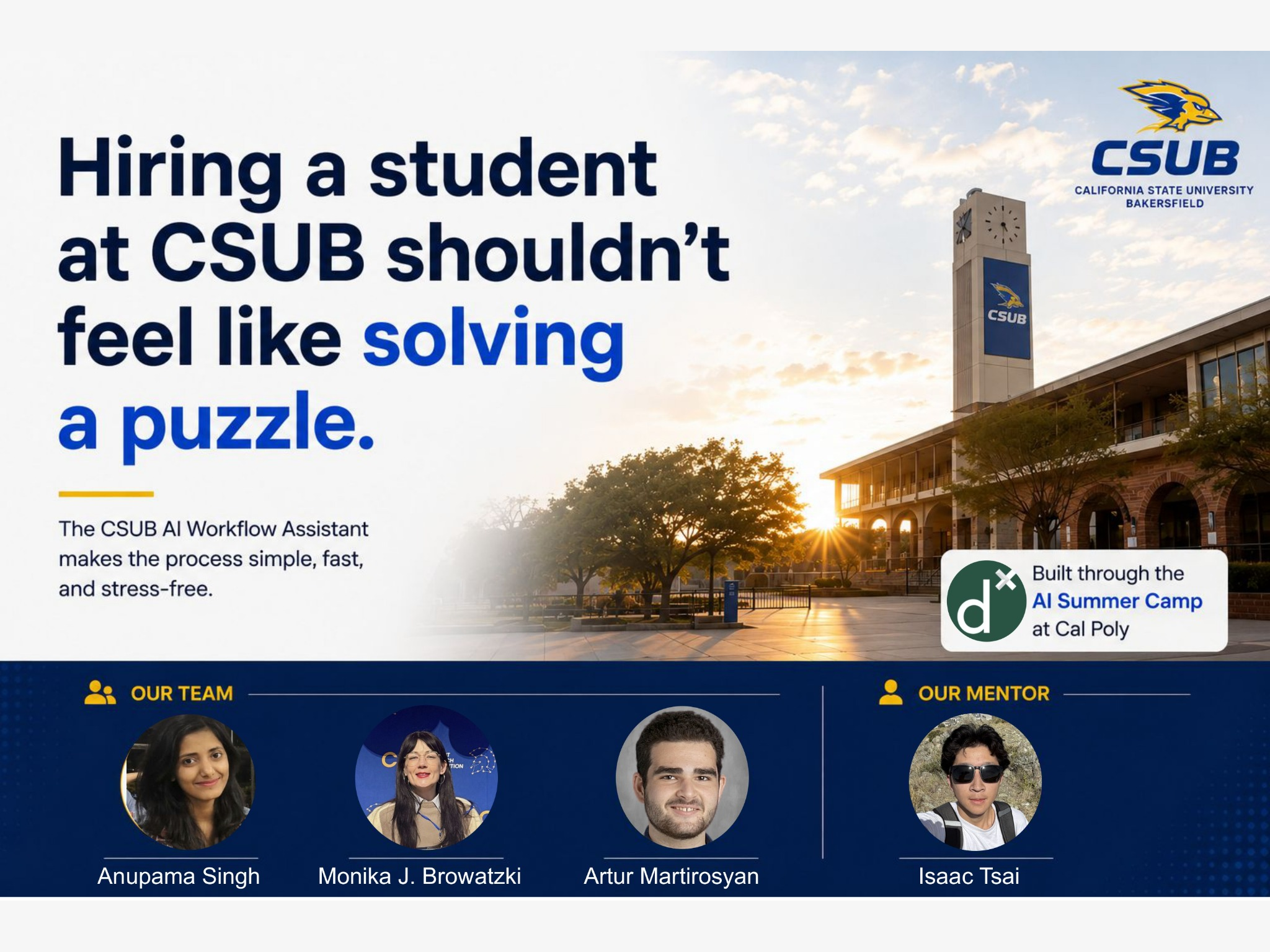
Team Participants:
Anupama Singh (California Polytechnic State University, Pomona)
Artur Martirosyan (Fresno State University)
Monika Jane Browatzki (California State University, Northridge)
“The assistant is designed to retrieve information directly from approved university documents to help users identify the correct forms, understand hiring policies, and receive grounded answers with citations.”
Problem
Staff and faculty at CSU Bakersfield’s College of Natural Sciences, Mathematics and Engineering need to know which form to use and who must sign it to hire a student assistant, but those requirements are undocumented and shift with the funding source behind each hire. This leaves the dean’s office fielding high volumes of repetitive procedural questions about requirements scattered across policy documents, internal routing guides, and grant spreadsheets. This knowledge-dependent model consumes administrative capacity that could be better spent on higher-value work, and makes onboarding new department coordinators slow. The existing workflow results in misrouted forms that must be canceled and restarted, delayed hires, and students occasionally beginning work before their employment is formally processed.
Technical Solution
The Student Hiring Assistant team developed an AI-powered web application that guides CSU Bakersfield staff through student hiring workflows by combining a conversational chatbot with structured decision logic to help users identify the correct forms, approval paths, and grant information. The solution is built as a Next.js application with a modular Decision Engine architecture that separates intent detection, conversation state tracking, workflow rules, grant lookup, and response generation into independently testable components, and it integrates Amazon Bedrock (managed generative AI) and Amazon Bedrock Knowledge Bases (managed RAG) to answer policy questions grounded in official university documents stored in Amazon S3 (cloud storage). When a staff member asks about hiring a student, the intent detector classifies the request—workflow questions like form selection and approval routing use deterministic business rules coded from institutional policies, grant-related questions search structured spreadsheet data to retrieve Fund #, PI, analyst, project number, and CO-PI information, and open-ended policy questions retrieve supporting passages from the knowledge base and return answers with source citations. To keep the knowledge base current, the system includes an automated document ingestion pipeline using AWS Lambda (serverless compute) that monitors Amazon S3 for newly uploaded files, extracts text from PDFs and Word documents directly or from scanned images using Amazon Textract (document text extraction), normalizes the content, and triggers a Bedrock Knowledge Base sync to make the information immediately available for retrieval. The assistant follows strict safety guardrails—it never invents policies or guesses missing information, asks clarifying follow-up questions when details are incomplete, and directs users to the appropriate university office (Grants Office, Dean’s Office, Payroll) when a question falls outside its supported scope. By centralizing guidance and grounding answers in approved institutional sources, the system reduces repetitive administrative inquiries, improves consistency in form selection and routing decisions, and helps staff reach the correct next step more efficiently while keeping final decision-making authority in human hands.
Showcase
| Presentation Recording | A recording of AI Summer Camp students presenting their project. |
| Slideshow | The accompanying slides shown in the video. |
| Source Code | All of the code and assets developed during the course of the AI Summer Camp. |
About the DxHub
The Cal Poly Digital Transformation Hub (DxHub) is a strategic relationship with Amazon Web Services (AWS) and is the world’s first cloud innovation center supported by AWS on a University campus. The primary goal of the DxHub is to provide students with real-world problem-solving experiences by immersing them in the application of proven innovation methods in combination with the latest technologies to solve important challenges in the public sector. The challenges being addressed cover a wide variety of topics including homelessness, evidence-based policing, digital literacy, virtual cybersecurity laboratories and many others. The DxHub leverages the deep subject matter expertise of government, education, and non-profit organizations to clearly understand the customers affected by public sector challenges and develop solutions that meet the customer needs.