
Team: Scheduler Tool Assistant
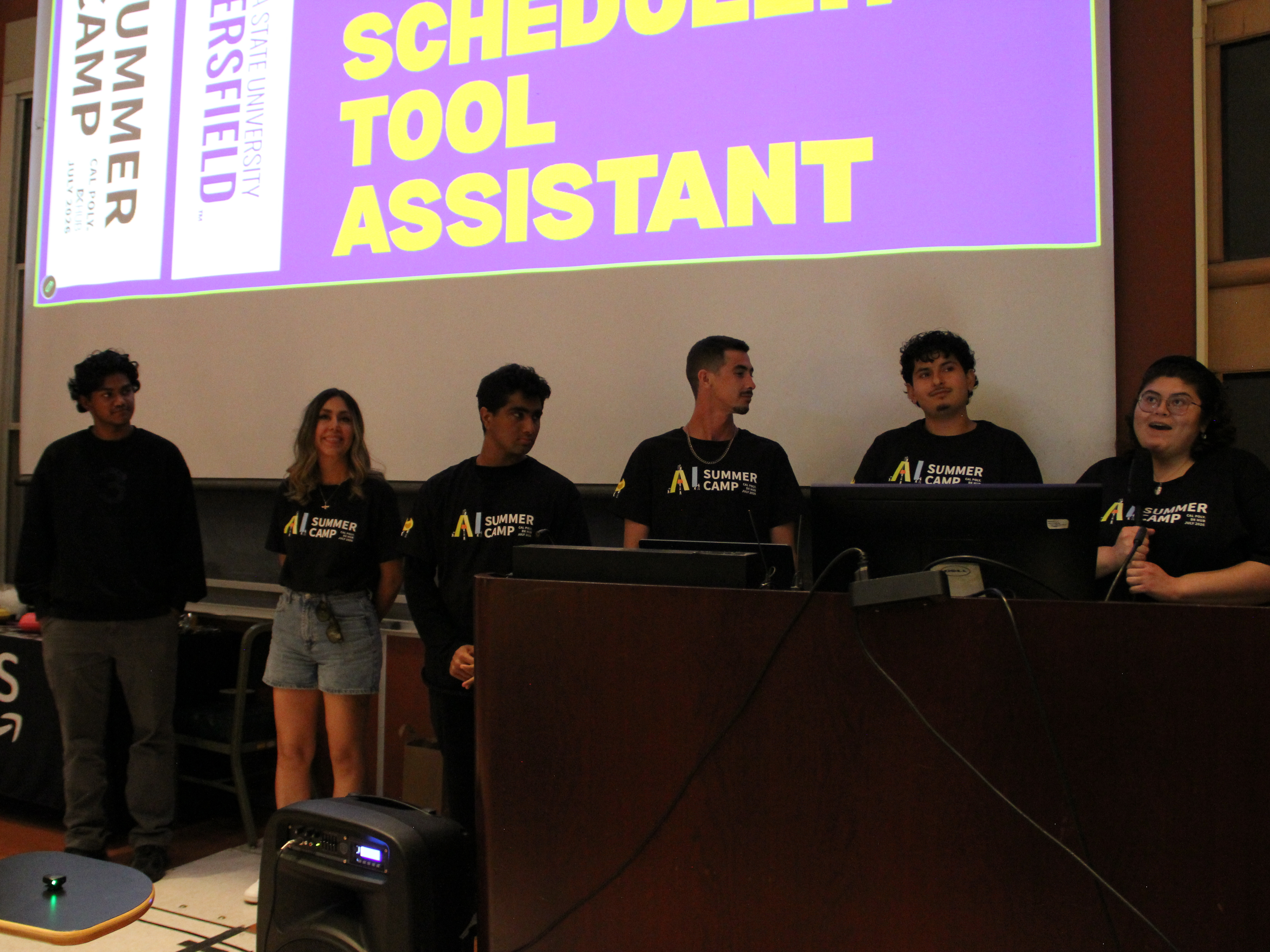
Team Participants:
Maryam Bavi (Sacramento State University)
River Covey (San Jose State University)
Daniel Lopez (California State University, Fullerton)
Abhiram Segu (San Jose State University)
Fatima Bazurto (California State University, Channel Islands)
Sanchit Kaushik (California State University, Long Beach)
“Creating a conflict-free roadmap-aligned schedule for each student which is no longer time-consuming and complex — it streamlines the whole process.”
Problem
Faculty and advisors at CSUB lack decision-support evidence on enrollment patterns, prerequisite necessity, and course success rates to inform curriculum planning and student scheduling. The current process for creating optimized block-registration schedules for incoming freshmen—combining math, English, and core major courses into cohesive 15-unit schedules—relies heavily on manual analysis of enrollment and academic data scattered across PeopleSoft, Runner Connect, and transfer transcript systems. Without data-driven insights into waitlist demand, section-shopping patterns, and time-to-degree impacts, curriculum review and advising become reactive rather than proactive. There is a need to empower faculty and advisors with decision support tools to better advise students.
Technical Solution
The Curriculum and Enrollment Decision-Support Models team developed a department-chair-facing scheduling tool that generates conflict-checked freshman course schedule blocks for BS Business Administration by combining real historical enrollment data, degree roadmaps, and actual Fall 2026 sections with an AI-powered what-if advisor. The solution follows a compute-first approach where all quantitative facts—course frequencies, unit totals, fit scores, prerequisite links, and degree-roadmap positions—are calculated deterministically in Python using pandas and dictionary lookups, and Amazon Bedrock (managed generative AI) only narrates the precomputed results in plain language with guardrails against inventing unsupported facts. A beam-search algorithm produces four to eight optimized schedule blocks per major scored on commuter-friendly time windows, popularity, seat availability, and compactness, with a deterministic validator that checks every block for time conflicts and missing requirements. The what-if advisor runs on AWS Lambda (serverless compute) behind Amazon API Gateway (API layer), executing pure-Python lookups against a precomputed degree-roadmap dataset in Amazon S3 (cloud storage) to answer questions like “what term is this course normally taken in” or “what would be delayed if I fail this course,” with Amazon Bedrock narrating the findings. The static frontend loads generated schedule artifacts client-side for the major picker, calendar view, and comparison features, and is deployed to Amazon S3 and served via Amazon CloudFront (content delivery network) with Origin Access Control for secure bucket access, providing evidence-based decision support while keeping final curricular decisions in faculty governance. All student data uses randomly assigned, non-reversible identifiers to protect privacy at this Hispanic-Serving Institution, and API Gateway throttling caps request volume.
Showcase
| Presentation Recording | A recording of AI Summer Camp students presenting their project. |
| Slideshow | The accompanying slides shown in the video. |
| Source Code | All of the code and assets developed during the course of the AI Summer Camp. |
About the DxHub
The Cal Poly Digital Transformation Hub (DxHub) is a strategic relationship with Amazon Web Services (AWS) and is the world’s first cloud innovation center supported by AWS on a University campus. The primary goal of the DxHub is to provide students with real-world problem-solving experiences by immersing them in the application of proven innovation methods in combination with the latest technologies to solve important challenges in the public sector. The challenges being addressed cover a wide variety of topics including homelessness, evidence-based policing, digital literacy, virtual cybersecurity laboratories and many others. The DxHub leverages the deep subject matter expertise of government, education, and non-profit organizations to clearly understand the customers affected by public sector challenges and develop solutions that meet the customer needs.