
Team: Golden Match
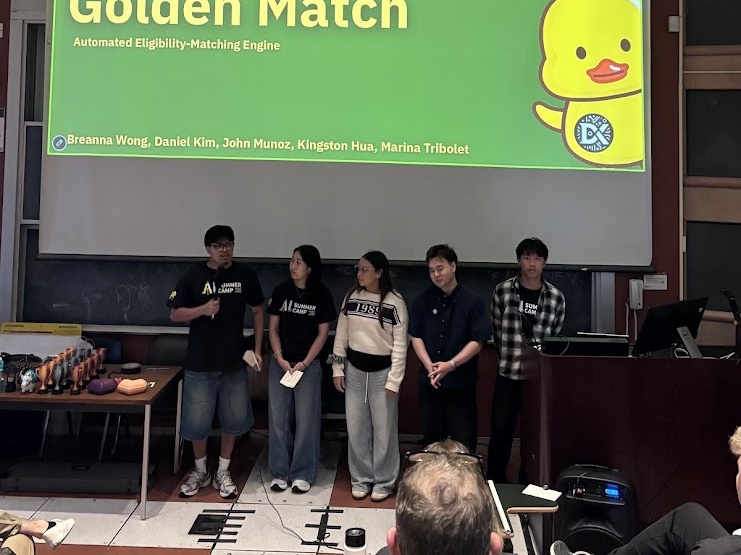
Team Participants:
- Breanna Wong
- Daniel Kim
- John Munoz
- Kingston Hua
- Marina Tribolet
“Out of 18,000 students, 9,000 qualified for financial or academic support programs, but only 600 applied to EOPS.”
Problem
Most eligible students never discover or apply for support programs like EOPS, CARE, CalWORKs, and Golden Promise, despite qualifying based on data the college already holds. Of approximately 9,000 students who qualify for financial aid, only around 600 (~3%) enroll in EOPS, representing a massive underutilization of available support services. The existing model places the burden on students to discover individual programs, understand eligibility criteria, and submit separate applications — a process that disproportionately excludes students with the greatest need and least institutional knowledge. This opt-in approach results in low program participation and missed opportunities to support student success when proactive, data-informed notification could reach eligible students directly.
Technical Solution
The Golden Match team developed an automated eligibility-matching system that proactively identifies students who qualify for campus support programs—including EOPS, CARE, CalWORKs, DSPS, NextUp, Veterans, Golden Promise, and Basic Needs—and notifies them with personalized invitations to opt in or opt out. The solution applies a rules-based eligibility engine that evaluates each student against fixed criteria drawn from FAFSA and CCC Apply data (income, Pell eligibility, enrollment units, first-generation status, foster youth status, and other legal requirements under California Title 5), then stores eligibility determinations and tracking status in Amazon DynamoDB (NoSQL database). For each qualified student, the system generates a personalized email with unique Accept and Opt-out links tracked by DynamoDB tokens, sent via Amazon SES (email delivery), and when students click, Amazon API Gateway (API layer) routes the request to AWS Lambda (serverless compute), which updates the student’s decision in DynamoDB in real time. A staff dashboard hosted on Amazon S3 (cloud storage) polls DynamoDB every five seconds to display program enrollment statistics, individual student responses, and time-based urgency alerts (24-hour yellow warnings, 48-hour red alerts), and the system enforces anti-spam rules—business hours only, three-day intervals, maximum three emails—then flags non-responders for phone outreach after three ignored emails. All data fields use a Slate-ready naming convention with an ep_ prefix, enabling direct CSV export for migration into Golden West College’s existing Slate CRM, so staff can efficiently identify, contact, and track the more than 9,000 eligible students who were previously unaware of or unable to access the support programs that provide textbook assistance, priority registration, dedicated counseling, and financial grants—ultimately increasing program enrollment, demonstrating student need for state funding, and reducing the barriers that keep students from the resources that improve retention and completion rates.
Showcase
| Presentation Recording | A recording of AI Summer Camp students presenting their project. |
| Slideshow | The accompanying slides shown in the video. |
| Source Code | All of the code and assets developed during the course of the AI Summer Camp. |
About the DxHub
The Cal Poly Digital Transformation Hub (DxHub) is a strategic relationship with Amazon Web Services (AWS) and is the world’s first cloud innovation center supported by AWS on a University campus. The primary goal of the DxHub is to provide students with real-world problem-solving experiences by immersing them in the application of proven innovation methods in combination with the latest technologies to solve important challenges in the public sector. The challenges being addressed cover a wide variety of topics including homelessness, evidence-based policing, digital literacy, virtual cybersecurity laboratories and many others. The DxHub leverages the deep subject matter expertise of government, education, and non-profit organizations to clearly understand the customers affected by public sector challenges and develop solutions that meet the customer needs.