
Team: Ekho Navigator
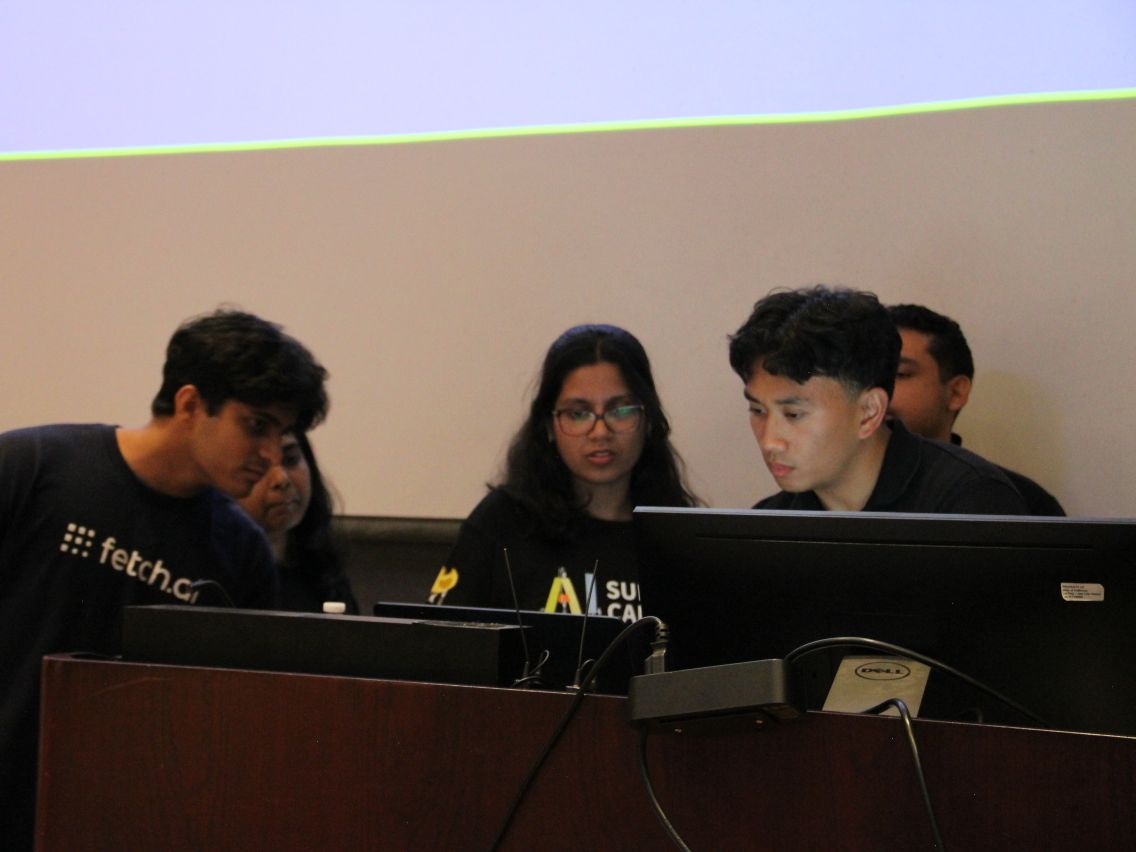
Team Participants:
Asher Drake Alacar (San José State University)
Mario Yanez (California State University, Fresno)
Alisha Sinha (San Francisco State University)
Renuka Prasad Patwari (San José State University)
Aalind Kale (California State University, Long Beach)
“Counselors spend 1,180 hours just answering the repeatedly asked questions. In terms of money, it could cost them about $51,000 a year.”
Problem
At CSU Channel Islands, students navigating questions about registration, degree requirements, financial aid, and campus services must search across fragmented university websites, academic catalogs, advising resources, and support center sites with no unified entry point. This scattered information landscape forces students to spend significant time hunting for answers to routine questions like ‘How do I change my major?’ or ‘Which classes fulfill my GE requirements?’, while advisors and student service offices handle high volumes of repetitive inquiries that could be self-served. Students struggle to find timely guidance grounded in official university policies, particularly during critical registration periods and major declaration deadlines. This fragmentation creates delays in academic planning and pulls staff away from high-touch advising to answer routine procedural questions.
Technical Solution
The Ekho Navigator team developed an AI-powered student guidance assistant for CSU Channel Islands that routes students, families, and prospective students to campus answers about registration, advising, financial aid, tutoring, and locations through structured decision-making where the model classifies needs into one of four actions rather than generating free-form text. The solution is built using a React and Vite frontend with streaming markdown replies, backed by AWS Lambda (serverless compute) orchestrator functions behind Amazon API Gateway that implement a safety-first architecture with deterministic crisis detection before any AI processing. Campus resource information scraped from CSUCI websites is stored in Amazon S3 (cloud storage) as Markdown documents with metadata sidecars, feeding into Amazon Bedrock Knowledge Bases (managed RAG) using Amazon Titan Text Embeddings to create vector representations stored in Amazon OpenSearch Serverless (search and vector index). When a student submits a question, the Lambda orchestrator first runs a deterministic safety filter that matches crisis keywords and immediately returns a canned response with 988 Lifeline and campus counseling contacts, bypassing all AI processing. For Spanish mode queries, Amazon Bedrock (managed generative AI) using Claude Haiku models translates the question to English before querying the Knowledge Base to maximize match quality, then forces the final reply to be fully Spanish. The orchestrator retrieves the top five passages from the Knowledge Base and sends them to Amazon Bedrock Converse API using Claude Sonnet 5 models with a tool configuration that forces the model to call exactly one of four tools—answer with numbered passage citations, ask a clarifying question, escalate to a specific campus office, or decline as out of scope. The model cites passages by number only, never emitting URLs, and code resolves the numbers to trusted source URLs from retrieved chunks, with invalid citations causing fail-safe escalation to a human. When the model escalates, code assembles an escalation card with verified contact details from an office directory covering financial aid, advising, registrar, tutoring, and general support, along with buttons to generate a support ticket with a staff-facing summary. The Lambda orchestrator validates every tool decision for structural correctness, with any unusable model output triggering fail-safe escalation and infrastructure errors returning retryable responses, while Amazon Bedrock Guardrails applies content filtering, PII masking, and grounding checks, and Amazon SNS (notifications and SMS) handles escalation notifications, providing CSU Channel Islands with a student support channel that routes directly to the correct service with grounded citations and deterministic safety handling for crisis situations.
Showcase
| Presentation Recording | A recording of AI Summer Camp students presenting their project. |
| Slideshow | The accompanying slides shown in the video. |
| Source Code | All of the code and assets developed during the course of the AI Summer Camp. |
About the DxHub
The Cal Poly Digital Transformation Hub (DxHub) is a strategic relationship with Amazon Web Services (AWS) and is the world’s first cloud innovation center supported by AWS on a University campus. The primary goal of the DxHub is to provide students with real-world problem-solving experiences by immersing them in the application of proven innovation methods in combination with the latest technologies to solve important challenges in the public sector. The challenges being addressed cover a wide variety of topics including homelessness, evidence-based policing, digital literacy, virtual cybersecurity laboratories and many others. The DxHub leverages the deep subject matter expertise of government, education, and non-profit organizations to clearly understand the customers affected by public sector challenges and develop solutions that meet the customer needs.