
AI-Powered EHS Training Recommendations for a Safer Campus

Overview
The Cal Poly Digital Transformation Hub (DxHub), powered by Amazon Web Services (AWS), partnered with California Polytechnic State University’s Environment, Health and Safety (EH&S) team to improve how safety training is identified and assigned.
EH&S staff previously relied on manual review of course descriptions, syllabi, and a Skillsoft library of more than 600 training modules to determine appropriate safety training. With thousands of academic offerings across Cal Poly, the standardized recommended training list was not consistent with the course requirements. This process was also time-intensive and difficult to apply consistently at scale.
DxHub developed an AI-powered EHS Training Reconciliation platform that analyzes course information and optional supplemental materials against the Skillsoft training catalog. The platform identifies potential safety hazards, surfaces relevant training (ie hazard based training), and provides Faculty and College staff with clear recommendations for their review and providing required trainings to their students.
Problem
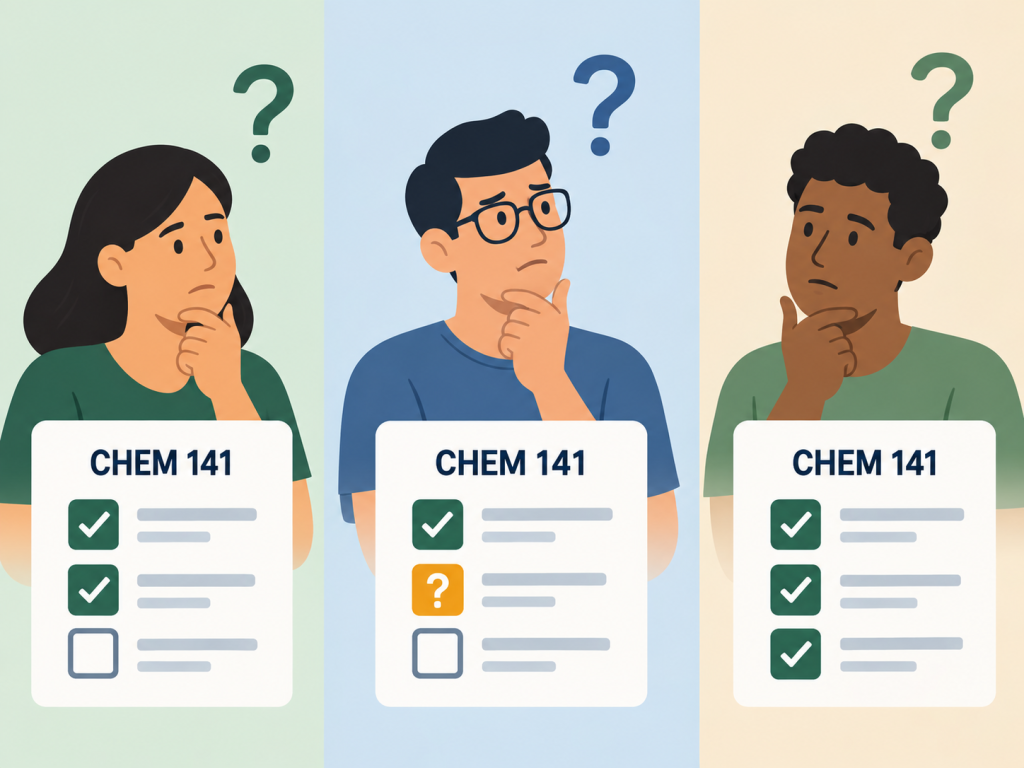
Cal Poly’s EH&S training assignment process has historically depended on staff expertise and distributed source materials. Reviewers must interpret course descriptions, read syllabi for hidden safety signals, and then search a catalog of more than 600 Skillsoft modules to decide what is required. Those steps take time, require domain knowledge, and can produce different outcomes depending on who is doing the matching.
Users must manually describe course activities, identify hazards, compare those hazards against a large training library, and determine which modules are likely required, possibly required, or not relevant. Outcomes can vary by department, by how detailed a syllabus is, and by how familiar the reviewer is with both the academic catalog and the Skillsoft library.
This creates several key challenges:
- High Manual Effort: Matching a single course can require reading catalog copy, reviewing a syllabus, and scanning hundreds of training titles. That increases time spent per course and slows campus-wide coverage.
- Inconsistent Training Assignment: Differences in judgment can lead to variability in which training is assigned for similar labs, shops, or field activities across departments.
- Catalog Scale and Change: Cal Poly maintains thousands of courses and as the university grows and converts catalogs, assigning training without a centralized, intelligent system becomes increasingly difficult.
These challenges highlight the need for a more automated, data-driven approach that can support consistent, efficient, and scalable EHS training reconciliation across the university.
Innovation In Action
To address these needs, DxHub developed an AI-powered EHS Training Reconciliation platform that automates and strengthens the course-to-training matching lifecycle.
Key innovations include:
- Unified Training Catalog: Skillsoft EHS content from PDFs, Excel catalogs, and Skillport pages is consolidated into a structured library of approximately 600 training modules. AI enriches each module with safety domains, hazards, activities, and keywords.
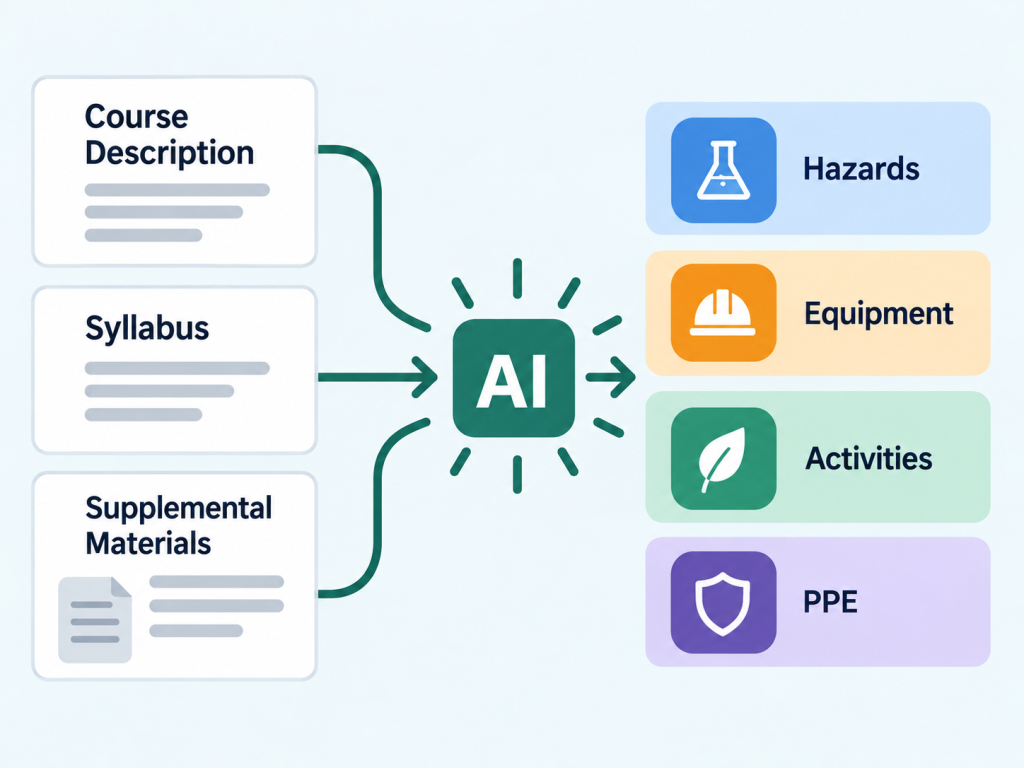
- Syllabus Safety Extraction: When a syllabus or supplemental material is provided, the platform identifies relevant topics, activities, equipment, materials, hazards, and PPE. This allows recommendations to reflect what happens in the course rather than relying solely on its catalog description.
- Semantic Search: Course information is compared with the training library using embeddings, allowing the system to identify relevant modules even when courses and trainings use different terminology.
- AI-Assisted Ranking: The platform combines semantic retrieval with large language model analysis to evaluate candidate trainings and classify them as likely required, possibly required, or not recommended. Each recommendation includes supporting reasoning and evidence for EH&S review.
- Reviewer Workflow: A centralized dashboard allows staff to search courses and trainings, review safety signals and recommendations, export results, and provide feedback on AI-generated suggestions.
Together, these features reduce reviewer burden, improve consistency in training assignment, and provide a more intelligent and scalable foundation for university-wide EHS operations.
Technical Solution
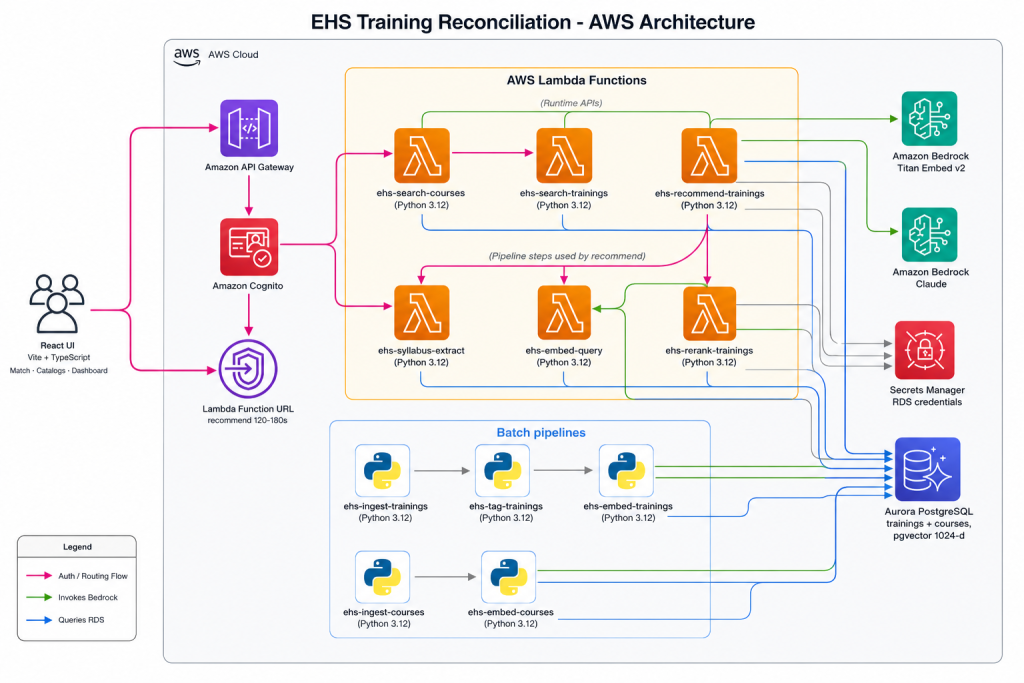
The platform includes a React-based web interface that enables Faculty and College & EHS staff to search courses, upload or paste syllabi, review extracted safety signals, and generate training recommendations through a centralized dashboard.
The backend is built on a serverless AWS architecture designed for scalable, secure, and intelligent matching. Amazon API Gateway serves as the entry point for application requests, routing them to AWS Lambda functions that handle course search, training search, recommendation generation, and reviewer feedback.
Catalog data is stored in Amazon Aurora PostgreSQL, enhanced with pgvector to support semantic similarity search across trainings and courses. Lambda functions generate embeddings with Amazon Titan Text Embeddings V2, retrieve similar historical trainings, and integrate with large language models via Amazon Bedrock (Claude) to tag trainings, extract syllabus safety content, and rerank recommendation candidates.
Authentication is managed through Amazon Cognito, enabling secure access for staff. The recommendation pipeline runs in two stages: vector retrieval over the embedded Skillsoft catalog, followed by Claude reranking that returns structured justifications and evidence for each suggested training.
This architecture enables a fully managed system that combines structured catalog data, semantic search, and AI-driven workflows to support consistent, enterprise-scale EHS training reconciliation.
Next Steps
The EHS Training Reconciliation platform gives Faculty and College and EH&S staff a centralized and scalable way to evaluate safety training needs across Cal Poly.
By automatically extracting safety information and searching the full training catalog, the platform reduces manual effort and helps reviewers make more consistent training decisions. Explainable recommendations allow staff to quickly understand why a training was suggested and focus their attention on validation, exceptions, and higher-risk cases.
The long-term goal is to extend the platform across the California State University (CSU) system, creating a shared approach to EHS training recommendations that can support multiple campuses while still allowing each institution to account for its own courses, safety requirements, and training needs.

Supporting Documents
| Source Code | All of the code and assets developed during the course of creating the prototype. |
About the DxHub
The Cal Poly Digital Transformation Hub (DxHub) is a strategic relationship with Amazon Web Services (AWS) and is the world’s first cloud innovation center supported by AWS on a University campus. The primary goal of the DxHub is to provide students with real-world problem-solving experiences by immersing them in the application of proven innovation methods in combination with the latest technologies to solve important challenges in the public sector. The challenges being addressed cover a wide variety of topics including homelessness, evidence-based policing, digital literacy, virtual cybersecurity laboratories and many others. The DxHub leverages the deep subject matter expertise of government, education, and non-profit organizations to clearly understand the customers affected by public sector challenges and develop solutions that meet the customer needs.