
Team: Golden West Transcript Assistant
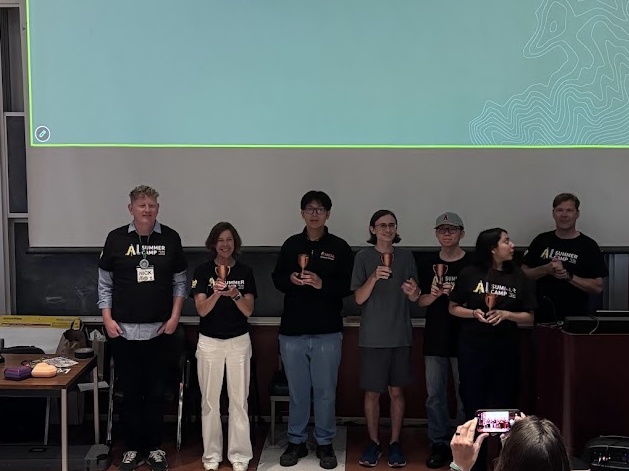
Team Participants:
- Laurel Skurko
- Liam Dorsey
- Esmeralda Lopez
- Minh Khoa Pham
- Robin Rhim
“Students usually face the uncertainty of long time waits for transcript evaluation, usually 7 to 10 days of business or even longer.”
Problem
Transcript evaluators manually parse unstructured PDFs from external institutions, perform course-to-course equivalency checks against articulation agreements and catalogs, and document credit recognition decisions for each student. This time-consuming workflow creates significant operational bottlenecks, particularly during high-volume periods like nursing application windows when approximately 1,000 transcripts arrive within two weeks. The manual process delays students from clearing prerequisites and registering for classes, consuming evaluator capacity that could be better spent on complex transfer cases requiring professional judgment. The existing workflow lacks standardization across evaluators and institutions, resulting in inconsistent turnaround times and credit awards that leave incoming and returning students without immediate clarity on their academic standing.
Technical Solution
The Golden West Transcript Assistant team developed an AI-powered articulation platform that automates the labor-intensive process of evaluating whether courses from out-of-state and private institutions satisfy Golden West College’s degree requirements, reducing what was a ten-week manual review of 2,000 applications down to one week. The system uses Amazon Bedrock Data Automation with custom blueprints to extract structured student and course data from uploaded transcript PDFs, whether printed or scanned, and stores the parsed profiles and course histories in Amazon Aurora (relational database) for queryable access, while course catalog descriptions from transfer institutions are indexed separately to serve as the source of truth for equivalence reasoning. When an evaluator initiates an articulation run for a student’s chosen major, AWS Step Functions (event scheduling/orchestration) launches a durable, parallel workflow in which AWS Lambda (serverless compute) functions retrieve the required courses for that degree program and the student’s completed courses, resolve both sets to their full catalog descriptions, and then call Amazon Bedrock (managed generative AI) foundation models to match likely candidate pairs, assess equivalence by comparing the actual course content rather than relying on course codes alone, and generate a decision for each pairing with a confidence score and a written rationale explaining the match or gap. The articulation results are stored in Amazon DynamoDB (NoSQL database) and exposed through a React single-page dashboard hosted on Amazon S3 (cloud storage) behind Amazon CloudFront (content delivery network), with Amazon API Gateway (API layer) routing backend requests, and the dashboard presents each required course alongside the matched transfer course with side-by-side descriptions and the AI’s recommendation so that evaluators retain final authority to agree, override, add notes, and record a formal decision. By automating the mechanical search-and-compare steps and surfacing evidence-backed recommendations, the platform reduced per-application evaluation time from 120 minutes to 10 minutes, compressed the two-week evaluation cycle that previously consumed 2.5 weeks per evaluator down to a single day of work per evaluator, and delivered $12,833 in cost savings while improving consistency and letting evaluators focus their expertise on the true judgment calls rather than page-by-page catalog lookups.
Showcase
| Presentation Recording | A recording of AI Summer Camp students presenting their project. |
| Slideshow | The accompanying slides shown in the video. |
| Source Code | All of the code and assets developed during the course of the AI Summer Camp. |
About the DxHub
The Cal Poly Digital Transformation Hub (DxHub) is a strategic relationship with Amazon Web Services (AWS) and is the world’s first cloud innovation center supported by AWS on a University campus. The primary goal of the DxHub is to provide students with real-world problem-solving experiences by immersing them in the application of proven innovation methods in combination with the latest technologies to solve important challenges in the public sector. The challenges being addressed cover a wide variety of topics including homelessness, evidence-based policing, digital literacy, virtual cybersecurity laboratories and many others. The DxHub leverages the deep subject matter expertise of government, education, and non-profit organizations to clearly understand the customers affected by public sector challenges and develop solutions that meet the customer needs.