
Team: Lambda Legion
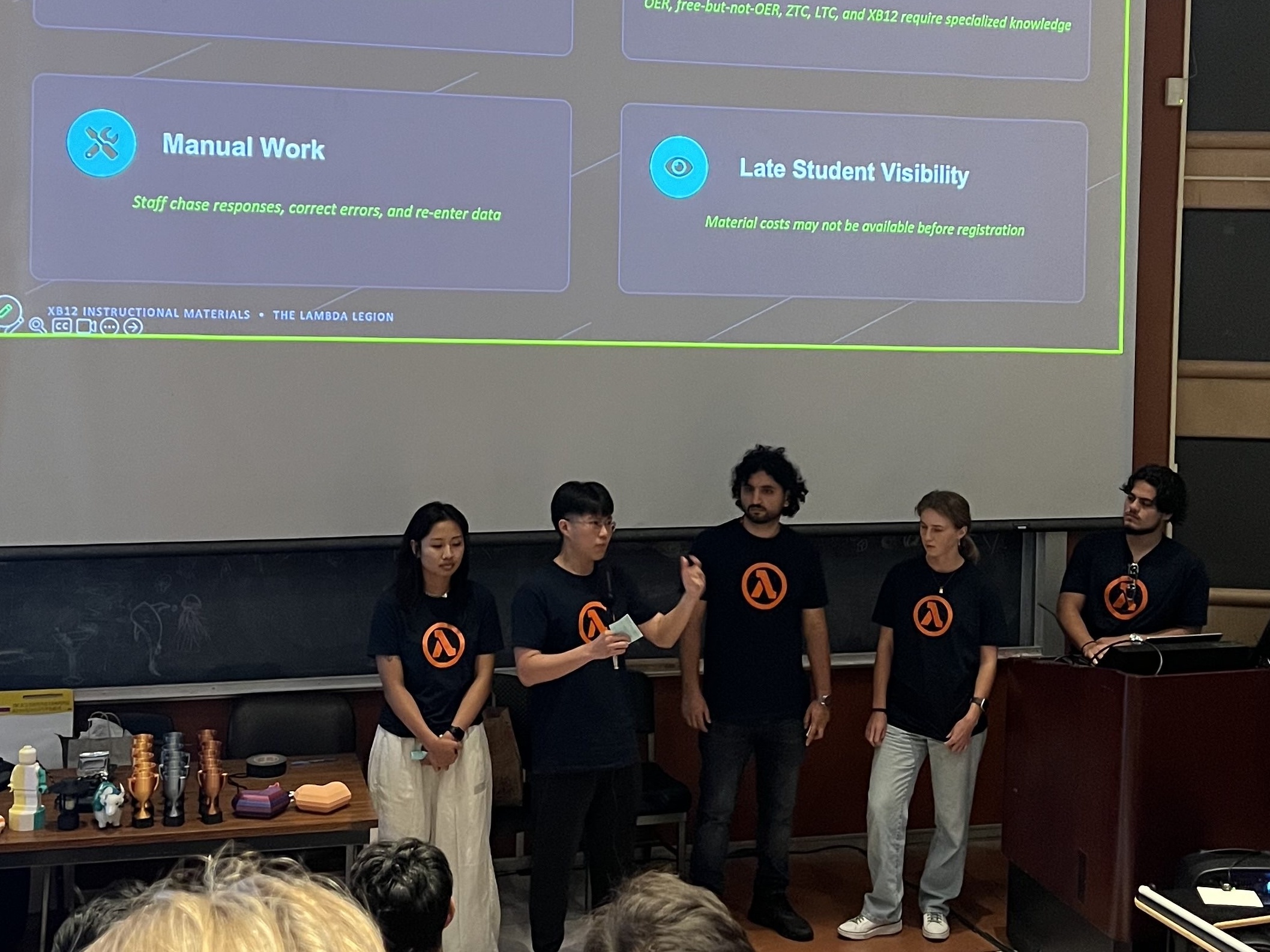
Team Participants:
- Anna Kozlov
- Brianna Miranda
- Mohammad Mahdi SaneiTaheri
- Nicolas Esquivel
- Nyi Htet
“Every quarter we have more than 100 courses, so that’s more than 500 texts that people have to do, and students cannot get access to course materials on time.”
Problem
Foothill-De Anza faculty and staff face the recurring burden of capturing instructional materials cost data across hundreds of course sections per term through manual survey-and-spreadsheet workflows that create bottlenecks, data entry errors, and reporting lag. Faculty members must manually report textbook and course materials costs through disconnected systems, resulting in duplicate data entry across the course schedule, bookstore ordering systems, and state compliance reporting (XB12, zero-cost, and low-cost course marking). This fragmented approach delays students from seeing cost information before registration opens, creates data quality issues that affect bookstore ordering and state reporting accuracy, and consumes significant faculty and staff time on repetitive administrative tasks. The lack of integration between systems means cost data captured once must be re-entered multiple times, creating inefficiency and missing state reporting deadlines for instructional materials compliance.
Technical Solution
The Lambda Legion team developed a cloud-based automation system that captures instructional materials cost data at a single entry point and routes it to downstream views including the bookstore, course catalog, and state MIS reporting. The solution is built as a serverless REST application using AWS Lambda (serverless compute) behind Amazon API Gateway, with data stored in Amazon DynamoDB, and it standardizes each section’s cost data with a rule-based classifier that derives the official California Community Colleges XB12 instructional-material-cost code from the adopted materials. To help faculty find and reuse low-cost and Open Educational Resource materials, the platform provides semantic search using Amazon OpenSearch Serverless with vector embeddings from Amazon Bedrock and enriches ISBN metadata from public book registries. After an admin review-and-approve step, the system publishes results to the downstream destinations, eliminating redundant data entry, reducing error rates, and supporting state reporting compliance while making cost data visible to students before registration. The bookstore, course catalog, and MIS reporting destinations are best-effort integration targets built for demonstration and are not concrete integrations with live external systems.
Showcase
| Presentation Recording | A recording of AI Summer Camp students presenting their project. |
| Slideshow | The accompanying slides shown in the video. |
| Source Code | All of the code and assets developed during the course of the AI Summer Camp. |
About the DxHub
The Cal Poly Digital Transformation Hub (DxHub) is a strategic relationship with Amazon Web Services (AWS) and is the world’s first cloud innovation center supported by AWS on a University campus. The primary goal of the DxHub is to provide students with real-world problem-solving experiences by immersing them in the application of proven innovation methods in combination with the latest technologies to solve important challenges in the public sector. The challenges being addressed cover a wide variety of topics including homelessness, evidence-based policing, digital literacy, virtual cybersecurity laboratories and many others. The DxHub leverages the deep subject matter expertise of government, education, and non-profit organizations to clearly understand the customers affected by public sector challenges and develop solutions that meet the customer needs.