
Team: Pink Panther
- Agustin Naranjo
- Amir Reza Sanei Taheri
- Carlos Garzaq
- Nathan Le
- Kim Khanh Tran
“Pink Panther leverages AWS infrastructure and AI to transform long mundane subjects into interactive modules, streamlining onboarding processes and mass trainings.”
Problem
New faculty face a static, overwhelming onboarding experience consisting of a scattered stack of links and documents that requires them to self-navigate Canvas training without guidance. This includes independently managing steep learning curves for tasks like setting up course shells, configuring gradebooks, and exporting grades, with minimal hand-holding through the sequenced steps needed for success. This unstructured, self-service approach consumes significant one-on-one support time from instructional designers and results in inconsistent completion rates and delayed course readiness. With new instructors onboarding each term across the institution, the existing workflow creates bottlenecks that strain instructional design staff availability. The heavy reliance on passive documentation over structured, interactive guidance means faculty new to online teaching struggle to build competency, consuming time that could be better spent on pedagogical mentoring and course quality improvement.
Technical Solution
The Pink Panther team developed a conversational AI training platform that walks new faculty through Canvas onboarding with a structured, sequential learning experience that replaces scattered static documents and videos. Built on a serverless AWS architecture, the system uses AWS Lambda (serverless compute) to orchestrate the training workflow and Amazon DynamoDB (NoSQL database) to track faculty profiles, progress through each Canvas training module, and completion status in real time. The platform ingests existing training content—how-to documents, instructor-created videos, and college website resources—and stores them in Amazon Bedrock Knowledge Bases (managed RAG) so that the AI assistant can answer faculty questions with grounded, cited responses from Hartnell College’s approved materials rather than generating unverified information. Faculty members move through a stage-gated path where each module presents interactive learning activities including flashcards, quizzes, and matching exercises, with an on-demand AI assistant (“Panther”) available to provide contextual guidance when instructors get stuck on a Canvas task, replacing the fragmented stack of links and resources that previously required one-on-one phone support from the LMS administrator. Training coordinators see a live progress dashboard that surfaces which faculty are on track and which are blocked, giving visibility into completion rates and enabling proactive intervention for those who need help. The solution reduces the time cost of assembling and sequencing onboarding materials for each new hire and cuts down high-volume “I’m stuck on a step” support requests by delivering in-context guidance exactly when faculty need it, improving the new-instructor experience and reducing the support load on college staff.
Showcase
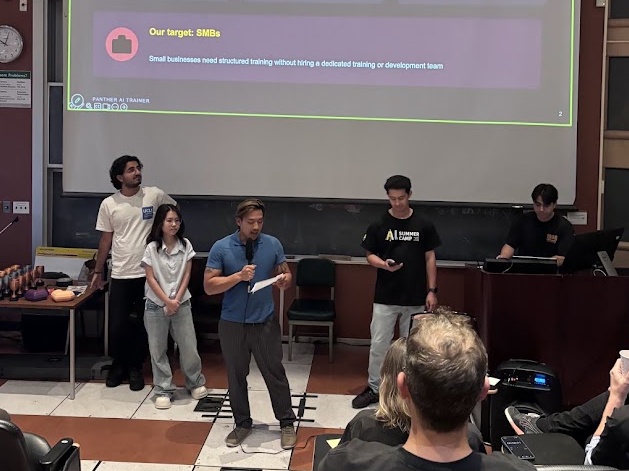
| Presentation Recording | A recording of AI Summer Camp students presenting their project. |
| Slideshow | The accompanying slides shown in the video. |
| Source Code | All of the code and assets developed during the course of the AI Summer Camp. |
About the DxHub
The Cal Poly Digital Transformation Hub (DxHub) is a strategic relationship with Amazon Web Services (AWS) and is the world’s first cloud innovation center supported by AWS on a University campus. The primary goal of the DxHub is to provide students with real-world problem-solving experiences by immersing them in the application of proven innovation methods in combination with the latest technologies to solve important challenges in the public sector. The challenges being addressed cover a wide variety of topics including homelessness, evidence-based policing, digital literacy, virtual cybersecurity laboratories and many others. The DxHub leverages the deep subject matter expertise of government, education, and non-profit organizations to clearly understand the customers affected by public sector challenges and develop solutions that meet the customer needs.