
Team: Policy Intelligence
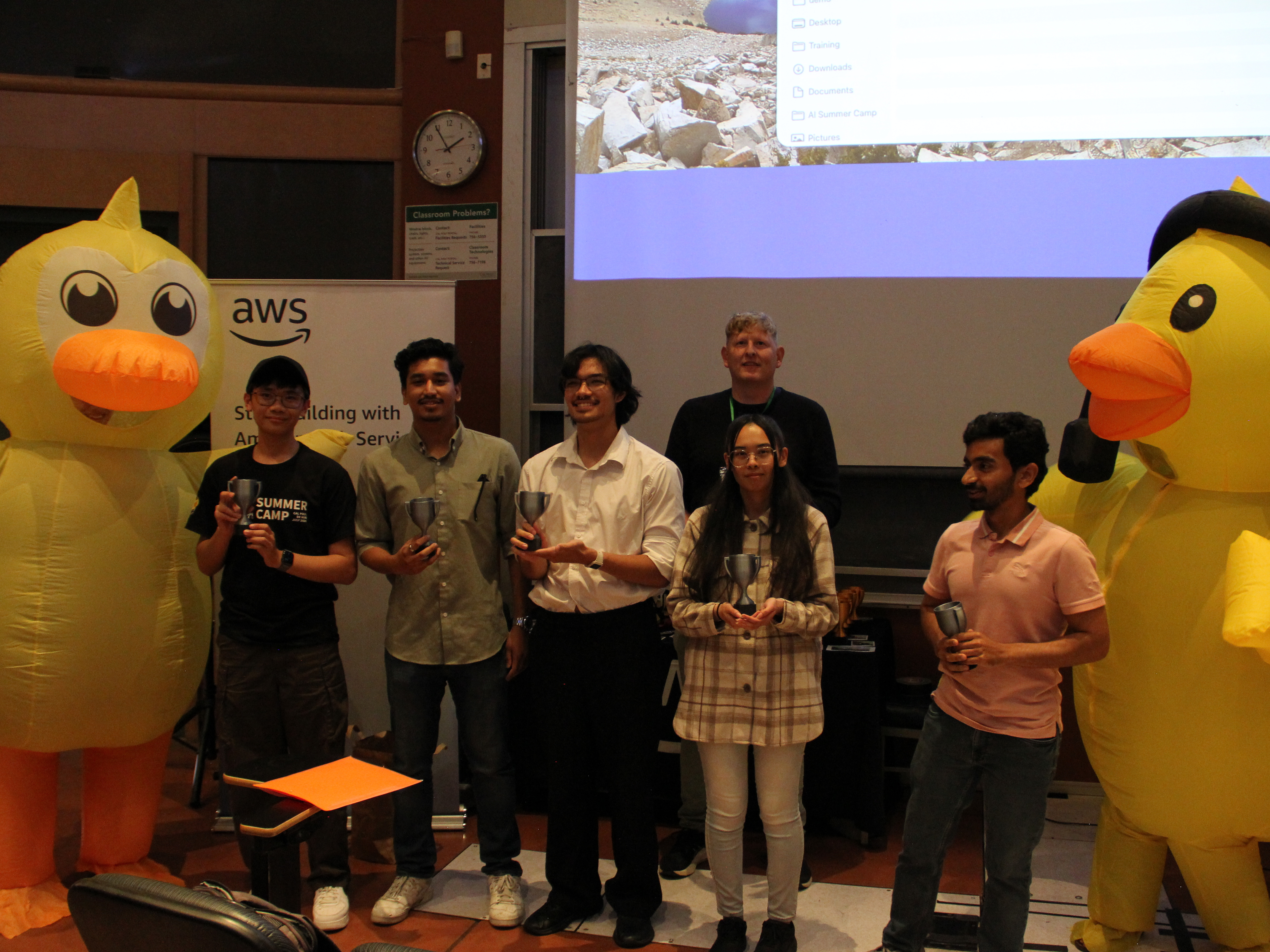
Team Participants:
Siddhant Raje (San Jose State University)
Yaza Myo Tun (California Polytechnic State University, Pomona)
Alyssa Muldong (California State University, Northridge)
Jo Trotechaud (California State University, San Bernardino)
Timothy Ou (California State University, Fullerton)
“During our discovery call, we learned that it’s going to be an estimated about 10 people just manually reviewing documents and low estimate, that’s 10K every single month going down the drain, just looking through documentation.”
Problem
At CSUB, faculty and staff face challenges navigating complex academic policies and senate resolutions, requiring significant time to locate relevant guidance and interpret procedural requirements across scattered documentation. The Academic Affairs Office relies on manual research of policy documents and historical senate actions, creating inefficiencies in decision-making and governance processes that delay critical academic initiatives. Without centralized, conversational access to policy knowledge, academic affairs personnel spend valuable time searching through fragmented documentation instead of focusing on strategic planning and faculty support. This fragmentation leads to inconsistent policy interpretation, delayed governance workflows, and difficulty surfacing relevant precedents when making decisions.
Technical Solution
The Policy Intelligence team developed a dual-mode policy search assistant that helps CSU Bakersfield employees ask cited, conflict-aware questions about academic policies and enables policy makers to check draft resolutions for overlaps, duplicates, and conflicts against the existing policy corpus through a persistent drafting workspace with a reviewable conflict log. The solution is architected to run either locally with deterministic hash-based retrieval and SQLite persistence for zero-AWS demos, or in full AWS mode where individual services activate via environment variable gating—retrieval switches to Amazon Bedrock Knowledge Bases (managed RAG) with embeddings from Amazon Bedrock using Titan Text Embeddings V2 stored in Amazon OpenSearch Serverless (search and vector index), generation routes through the Strands agent orchestrator wrapping Amazon Bedrock (managed generative AI), and persistence moves to Amazon DynamoDB (NoSQL database) for the conflict log, source registry, upload tracking, permissions, draft versions, feedback, and recurring questions, with draft version bodies stored in Amazon S3 (cloud storage). When a user asks a policy question, a six-agent conflict pipeline runs in parallel—extractors identify potentially conflicting sources, a verifier programmatically checks spans against source text to prevent hallucinated conflicts, and a variance layer applies soft re-labeling over the pipeline output to adjust severity—and the system returns a grounded answer with citations, an optional conflict banner with escalation guidance shaped by the user’s role (employees see softened guidance with raw conflict details stripped, reviewers see full conflict sources and IDs), and a complete agent trace for transparency. The resolution checker allows policy makers to paste draft text and receive overlap and conflict analysis with recommendations, while the conflict log accumulates all detected policy conflicts with metadata for administrative review. Security is enforced through Amazon Bedrock Guardrails to block prompt injection attacks, source governance at the API boundary with per-user grants managed via Amazon Cognito (authentication) where source owners need edit permissions to modify existing sources, and API throttling via Amazon API Gateway (API layer) to prevent automated abuse. The backend is built with FastAPI wrapped by Mangum for AWS Lambda (serverless compute) deployment, and a store abstraction layer allows seamless switching between SQLite and DynamoDB per table without duplicating code paths, enabling the team to incrementally adopt AWS services while maintaining a fully functional local demo throughout development.
Showcase
| Presentation Recording | A recording of AI Summer Camp students presenting their project. |
| Slideshow | The accompanying slides shown in the video. |
| Source Code | All of the code and assets developed during the course of the AI Summer Camp. |
About the DxHub
The Cal Poly Digital Transformation Hub (DxHub) is a strategic relationship with Amazon Web Services (AWS) and is the world’s first cloud innovation center supported by AWS on a University campus. The primary goal of the DxHub is to provide students with real-world problem-solving experiences by immersing them in the application of proven innovation methods in combination with the latest technologies to solve important challenges in the public sector. The challenges being addressed cover a wide variety of topics including homelessness, evidence-based policing, digital literacy, virtual cybersecurity laboratories and many others. The DxHub leverages the deep subject matter expertise of government, education, and non-profit organizations to clearly understand the customers affected by public sector challenges and develop solutions that meet the customer needs.