
Team: Procure Ducktives
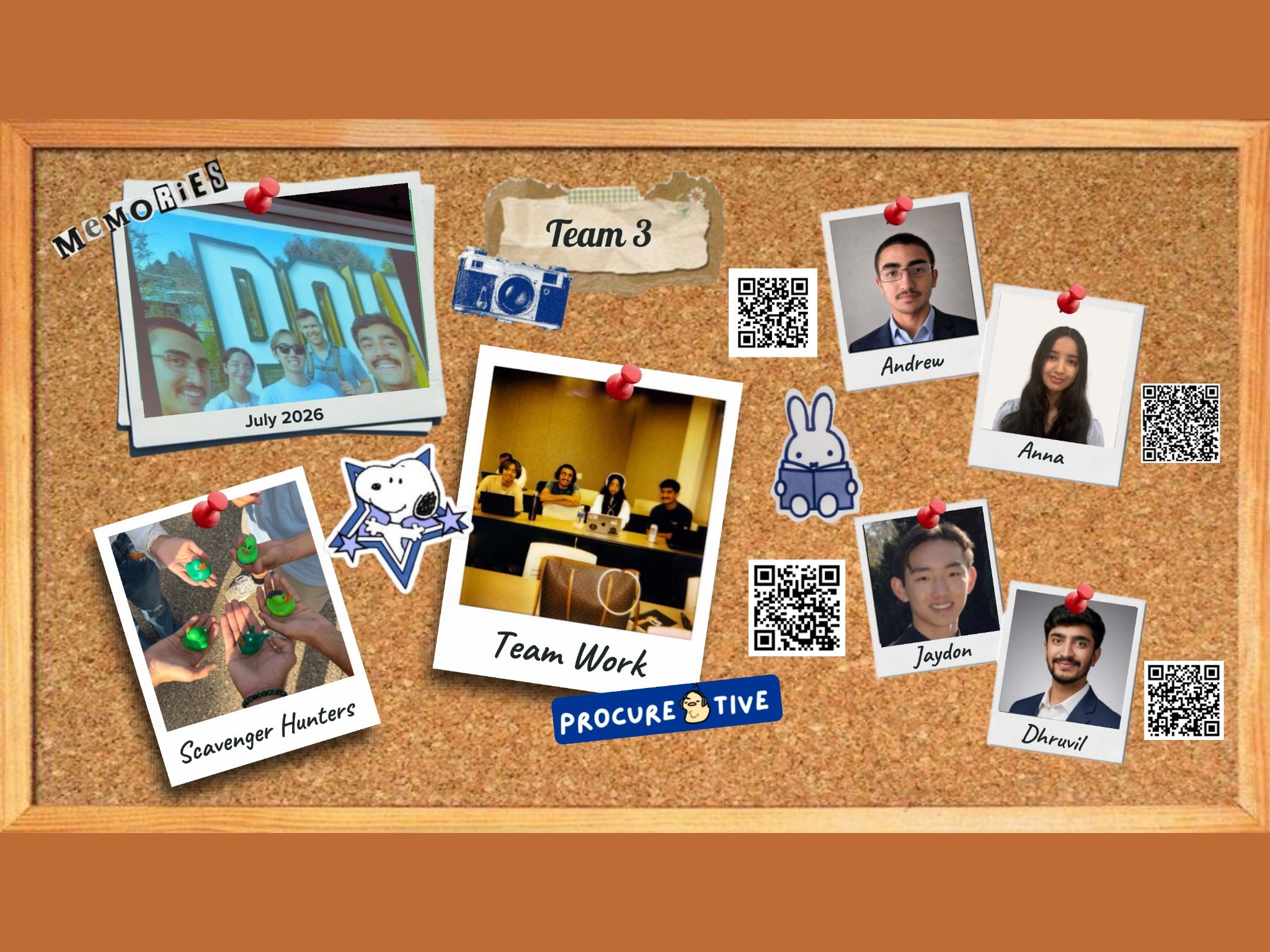
Team Participants:
Jaydon Chen (California Polytechnic State University, San Luis Obispo)
Anna Sehgal (California State University, Chico)
Andrew Garcia Leopold (California State University, Northridge)
Dhruvil Kumbhani (California State University, San Bernardino)
“Procurement users do not just need more sources or more related answers, they need the right answer in the right context with clear next steps.”
Problem
CSUB’s purchasing and procurement processes require significant manual effort to manage vendor submissions, validate documentation, and coordinate approvals across multiple departments. Faculty and staff requesters face delays and uncertainty navigating procurement workflows, while procurement staff spend substantial time on routine verification and document assembly tasks. The lack of self-service vendor submission guidance and document validation leads to incomplete submissions, extended procurement cycles, and administrative bottlenecks. Without streamlined triage and preparation workflows, low-complexity procurement requests can take weeks rather than days to process diverting valuable staff and faculty requestor time from higher value priorities like delivering high quality campus services and teaching.
Technical Solution
The Procure Ducktives team developed a role-aware procurement assistant that lets CSU Bakersfield requesters, vendors, and staff ask plain-language questions about purchasing workflows, supplier onboarding, invoice processing, and contract checks and get answers that cite the documents they came from. The solution runs on AWS Lambda (serverless compute) behind Amazon API Gateway (API layer) and reasons with Amazon Bedrock (managed generative AI), where Claude Sonnet writes the cited answer and Claude Haiku first sorts each question by intent and afterward confirms the answer stays grounded in the retrieved text. Approved procurement guides, manuals, and training-video transcripts produced with Amazon Transcribe (speech-to-text) are indexed in an Amazon Bedrock Knowledge Base (managed RAG), embedded with Amazon Titan Text Embeddings (text embedding model) and stored in Amazon OpenSearch Serverless (search and vector index), with internal-only material filtered out for public users and rule-based gates that turn away transaction requests and prompt-injection attempts before the model is ever called. Answers drawn from training videos return timestamped links to the original recordings in Amazon S3 (cloud storage) so users can jump straight to the relevant 90-second segment instead of watching the whole video, and the React front end is hosted on Amazon S3 and delivered through Amazon CloudFront (content delivery network). Testing across guided and adversarial scenarios confirmed valid citations, no leaks of internal-only sources, and answers in seconds, giving the campus community trustworthy self-service procurement guidance. Personalized status lookups, such as checking a specific requisition, were intentionally left for future work because they would require authenticated identity and a live connection to the campus procurement system.
Showcase
| Presentation Recording | A recording of AI Summer Camp students presenting their project. |
| Slideshow | The accompanying slides shown in the video. |
| Source Code | All of the code and assets developed during the course of the AI Summer Camp. |
About the DxHub
The Cal Poly Digital Transformation Hub (DxHub) is a strategic relationship with Amazon Web Services (AWS) and is the world’s first cloud innovation center supported by AWS on a University campus. The primary goal of the DxHub is to provide students with real-world problem-solving experiences by immersing them in the application of proven innovation methods in combination with the latest technologies to solve important challenges in the public sector. The challenges being addressed cover a wide variety of topics including homelessness, evidence-based policing, digital literacy, virtual cybersecurity laboratories and many others. The DxHub leverages the deep subject matter expertise of government, education, and non-profit organizations to clearly understand the customers affected by public sector challenges and develop solutions that meet the customer needs.